

The Spine Only Has Two Kinds of Tissue. Most Injury Evaluations Only Check One.
Written by Dr. Justin Dick, DC
When someone injures their back or neck, most providers reach for one tool: an X-ray to check for fracture. That’s appropriate. It rules out the most obviously serious injury. But it also means the evaluation stops at checking one of the spine’s two tissue types and largely ignores the other.
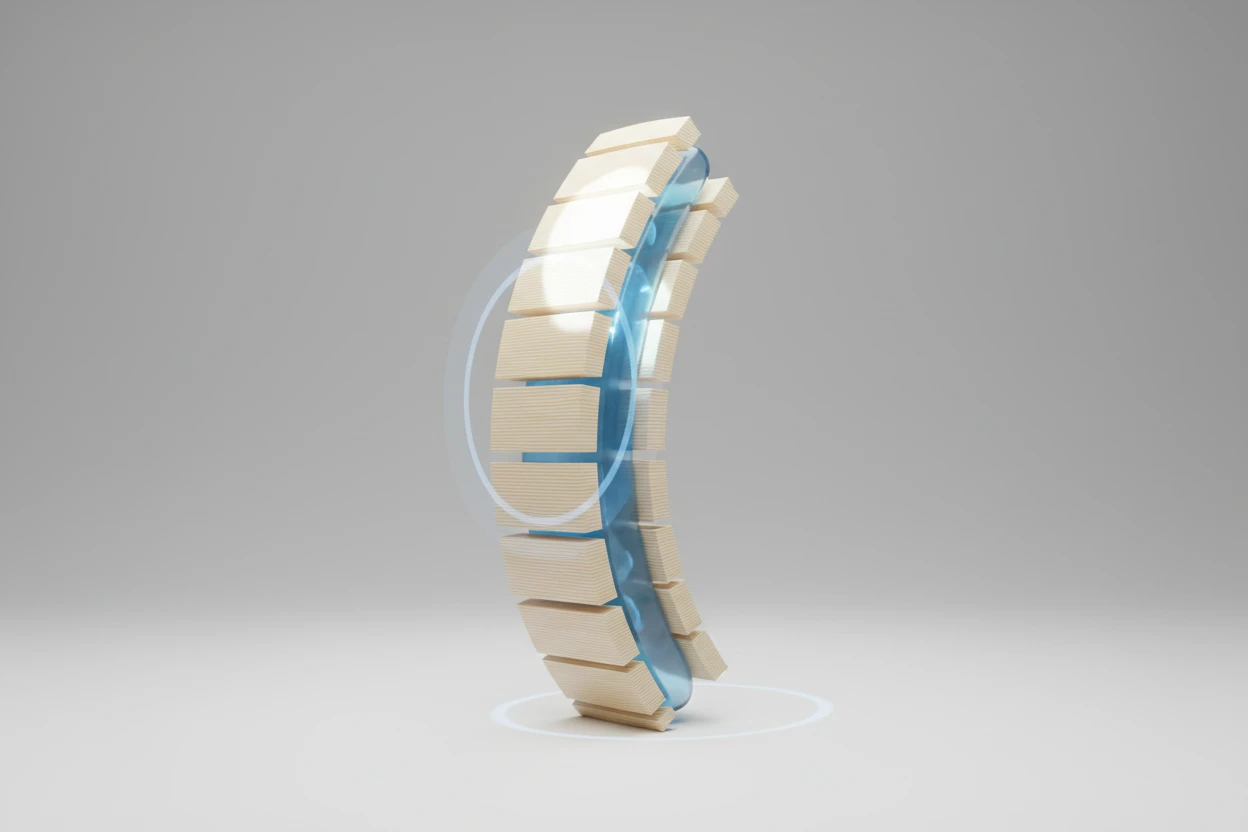
The spine is built from bone (vertebrae) and connective tissue (ligaments). Fractures are bone injuries, and standard X-ray catches them reliably. Ligament injuries are a different story, and there are two distinct kinds that get treated as interchangeable when they aren’t.
The one most people have heard of is a disc herniation. Discs are shock-absorbing ligaments between vertebrae, and when they’re damaged, an MRI is the appropriate tool to confirm it. Disc injuries are real and can be painful. In my experience they aren’t usually what drives someone into years of chronic, hard-to-explain pain.
The injury that does that more often is damage to the spine’s support ligaments. This is the network that holds each vertebra in its proper position relative to the ones above and below it. When support ligaments are damaged, that segment of the spine loses its normal stability. Vertebrae shift more than they should during ordinary movement. This irritates the surrounding nerves and accelerates wear on the joint. This is the injury most commonly underlying chronic neck pain, chronic low back pain, and recurring headaches that never fully resolve. It’s also the one that gets missed most often. because standard imaging isn’t designed to detect it.
Detecting it requires a specific kind of imaging: stress X-rays, taken with the spine positioned in flexion and extension, that measure how much a segment moves relative to what’s normal. That measurement is what confirms instability, and it’s a different diagnostic question than “is anything broken” or “is a disc bulging.”
I documented a case that illustrates why this distinction matters, published as a peer-reviewed case report. A patient with pre-existing scoliosis presented after a motor vehicle collision. The pre-existing curvature meant the baseline spinal architecture wasn’t neutral to begin with. Which complicates the usual question of what changed as a result of the crash versus what was already there. Radiographic sagittal alignment measurements alongside neurological findings, tracked through a course of conservative cervical structural rehabilitation, showed measurable changes in alignment that correlated with the patient’s neurological presentation. That relationship, between structural alignment and functional neurological findings, is exactly the kind of thing a fracture check or a disc-focused MRI isn’t built to capture. It’s part of why trauma layered onto a pre-existing spinal condition needs its own evaluation logic rather than being folded into a generic “car accident injury” workup.
A few things worth knowing if you or someone you know is dealing with pain that started after an injury and hasn’t resolved:
A “normal” X-ray or MRI doesn’t rule out ligamentous instability. Those studies aren’t built to detect it, so a normal read on either one only tells you what it was actually looking for.
Chronic pain following trauma isn’t automatically something to accept as permanent. It’s often a sign that one part of the injury, usually the ligamentous instability piece, was never actually evaluated.
If pain persists beyond a few months after an injury and standard imaging came back clean, ask specifically whether spinal stability has been assessed. Not just whether anything is broken or bulging.
The larger point is that spinal injury isn’t a single category. It’s at minimum three distinct things, bone, disc, and ligamentous support. Each requires its own diagnostic approach. Treating them as one undifferentiated “back injury” is how people end up with years of unresolved pain and no clear explanation for why.
Author Bio: Dr. Justin Dick, DC, is the owner and treating clinician at Clear Life Scoliosis and Chiropractic Center in Charlotte, NC, and holds dual imaging credentials (CNMT, ARRT(N)(CT)). His peer-reviewed research includes a 2026 PubMed case report on cervical sagittal alignment and neurological outcomes following trauma. Learn more at clearlifescoliosis.com.