
By Jimi Patel
Most Amazon brands don’t have a PPC strategy problem, they have an account governance problem.
Having audited and scaled paid advertising campaigns for marketplace brands since 2014, our eStore Factory team consistently spots the same pattern in inherited accounts: well-intentioned campaigns launched during a product rollout, left unmonitored for months, and quietly draining ad spend.
Fixing this rarely requires reinventing your marketing strategy. It demands a disciplined, 30-day operational audit designed to isolate capital leaks and reallocate that budget directly into proven revenue drivers.
Here is the exact four-week framework we use to audit Amazon ad accounts and lift return on ad spend (ROAS).
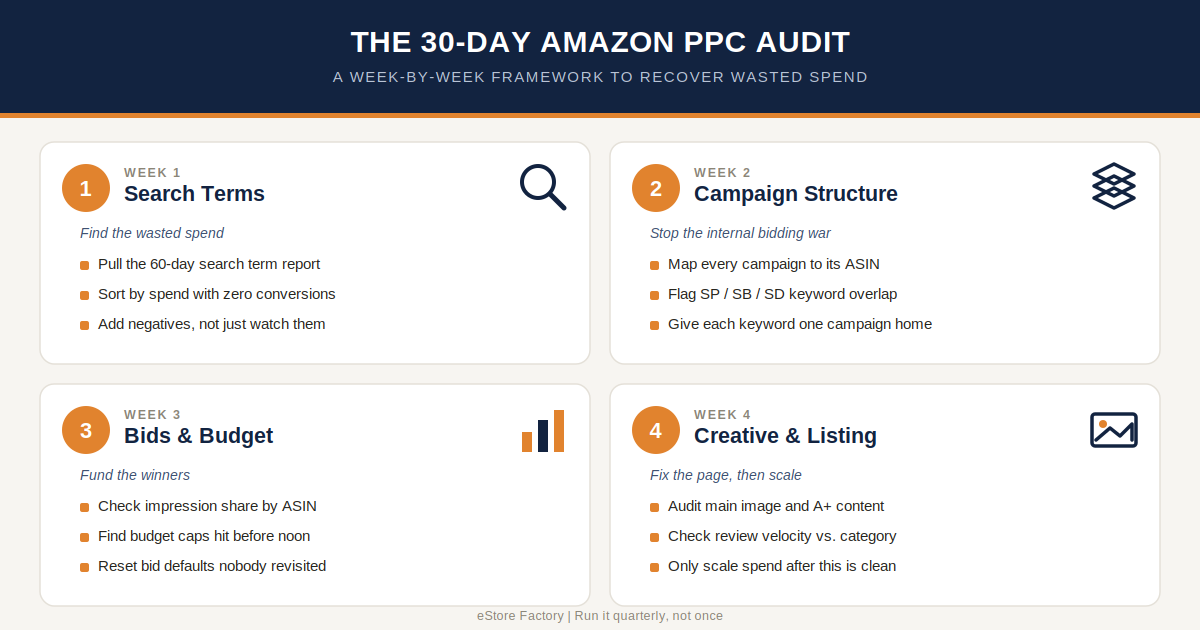
Week 1: Search Term Sanitization & Waste Elimination
Never start in the high-level campaign dashboard, start inside the Search Term Report. Dashboard averages often hide severe inefficiencies at the individual query level.
In our audits, trailing 30-to-60-day diagnostics routinely uncover 15% to 25% in pure ad waste. The primary culprit is legacy auto campaigns originally set up during product launches that were never pruned. Over time, these campaigns accumulate clicks on loosely related or non-converting search terms.
Action Item: Pull a 60-day Search Term Report. Filter for queries that have accumulated spend exceeding your target cost-per-acquisition (CPA) with zero sales. Add these immediately as Negative Exact matches at the ad group or campaign level. This single step stops immediate cash bleed without disrupting your top-performing targets.
Week 2: Campaign Architecture & Internal Cannibalization
As brands expand, marketing teams often launch new campaigns without archiving old ones. This results in the same ASIN competing against itself across Sponsored Products, Sponsored Brands, and Sponsored Display on identical keywords.
When multiple internal campaigns bid on the same term, you drive up your own cost-per-click (CPC) against your own inventory instead of external competitors.
Action Item: Map active campaigns directly against each ASIN. Isolate exact, broad, and auto targeting into dedicated campaign structures. Assign every target keyword a single, dedicated campaign home to eliminate internal bidding wars and enforce clean governance.
Week 3: Bid Calibration & Placement Multipliers
Once structural waste and internal overlap are resolved, evaluate placement performance: Top of Search (First Page), Rest of Search, and Product Pages.
A common operational pitfall is applying blanket bid increases across an entire campaign. Top-of-Search placements generally yield the highest conversion rates, whereas Product Page placements frequently accumulate low-intent impressions and burn budget.
Action Item: Pull the 30-day Placement Report. Calculate conversion rates per placement segment. Lower baseline keyword bids and apply aggressive bid modifiers (50% to 150%) strictly to Top-of-Search placements if that is where conversions concentrate. This maximizes top-of-page visibility while curtailing wasted spend on lower-converting placements.
Week 4: Strategic Budget Reallocation & Scaling
The final phase shifts the recovered capital directly into unconstrained growth.
A frequent issue in mature accounts is high-converting manual campaigns hitting their daily budget caps by early afternoon, while underperforming broad match campaigns continue spending through the evening.
Action Item: Reallocate capital freed up in Weeks 1 and 2 directly to campaigns maintaining an Advertising Cost of Sales (ACoS) well below target. Isolate your top 10% highest-converting search terms into dedicated Single Keyword Ad Groups (SKAGs) with dedicated daily budgets to scale revenue efficiently.
Key Takeaways for Directors
- Pruning beats bidding: You will recover more margin by systematically negating non-converting search terms than by micro-managing bid values.
- One keyword, one home: Internal keyword cannibalization is one of the most common drivers of inflated CPCs in growing accounts.
- Fund what converts: Placement modifiers and isolated high-performer budgets allow you to scale total sales volume without increasing your blended target ACoS.
About the Author
Jimi Patel is an e-commerce director and Amazon advertising strategist with over a decade of experience managing marketplace growth, campaign governance, and full-funnel PPC operations for global brands.
Connecting Experts with Publishers
Connectively connects subject-matter experts with top publishers to increase their exposure and create quality, ready-to-publish Q & A content.
About Connectively →