
Authored by Ginger Petrus
One of the things I’ve learned from working at Beacon Nonprofit and serving on a nonprofit board is how often the terms “nonprofit” and “501(c)(3)” are used interchangeably. I understand the confusion firsthand because I thought they meant the same thing, too. It’s understandable and very common. What makes it so confusing is that many organizations are both nonprofits and 501(c)(3)s.
But the terms don’t actually mean the same thing. Understanding the difference can make the formation process much clearer, especially when you’re trying to figure out what you’re applying for and what comes next.
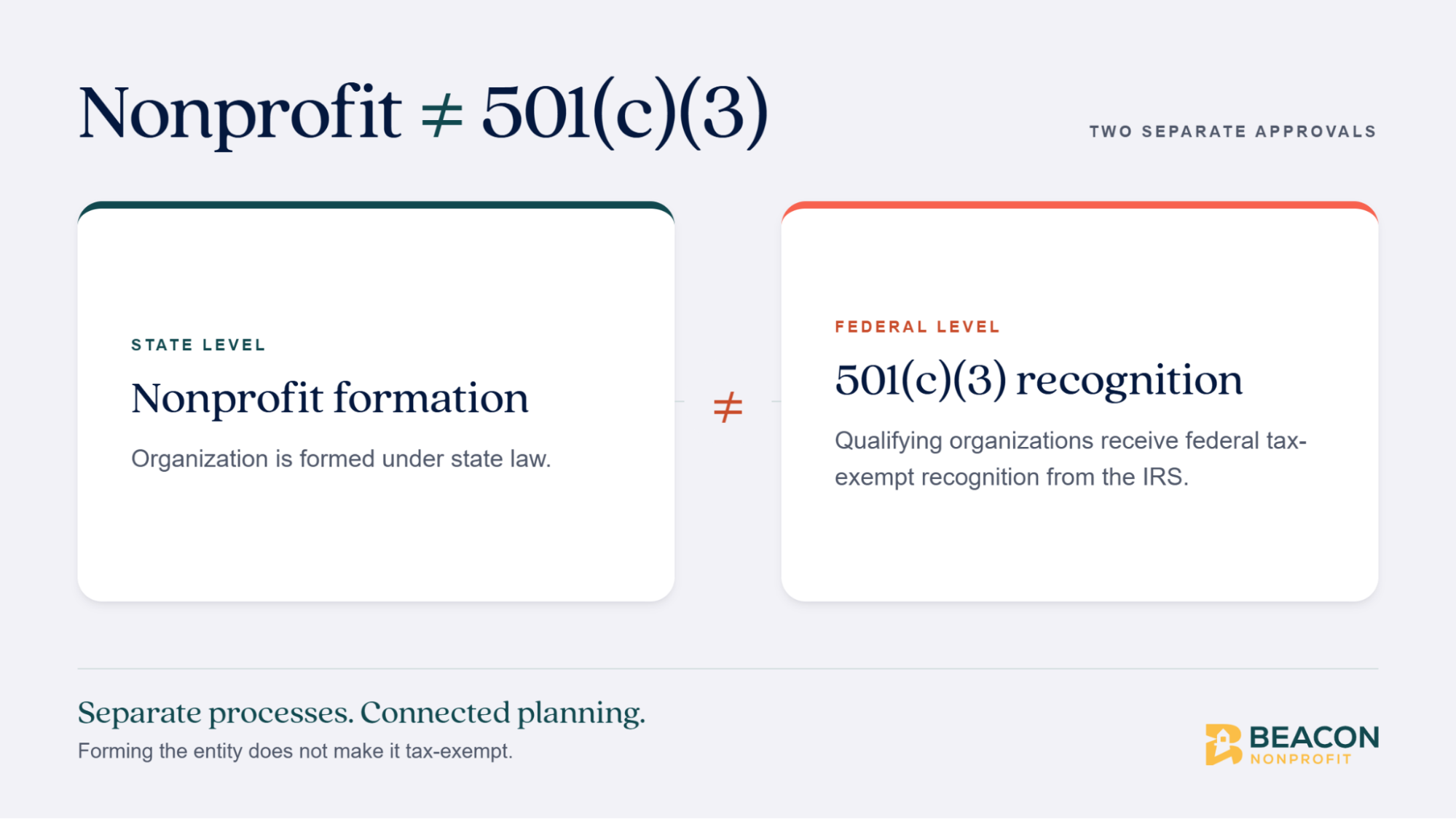
A Nonprofit Is Formed at the State Level
A nonprofit is an organization formed under state law. For a nonprofit corporation, that generally means filing Articles of Incorporation, or a similar document, with the appropriate state agency.
Formation typically involves decisions about the organization’s name, purpose, registered agent, initial directors, and governance. Requirements vary by state, so confirm the rules where you plan to form your organization.
The main distinction is that forming a nonprofit corporation with your state does not automatically give the organization federal 501(c)(3) status. State formation and federal tax-exempt recognition are separate processes.
For anyone at the beginning of the process, understanding the broader steps involved in forming a nonprofit can help put those two processes into context.
501(c)(3) Is a Federal Tax-Exempt Status
Section 501(c)(3) is part of the federal tax code. Organizations that qualify can receive exemption from federal income tax and must be organized and operated for qualifying exempt purposes, such as charitable, religious, educational, or scientific purposes.
Most organizations seeking recognition under Section 501(c)(3) apply to the IRS using Form 1023 or, if eligible, Form 1023-EZ. Some organizations, including churches and certain small organizations that meet IRS requirements, may be considered tax-exempt without filing either application.
That application comes after state formation, but the two steps should not be planned in isolation.
State Formation and 501(c)(3) Status Are Connected
Separate does not mean unrelated, and this is where I think the most important nuance lives.
If an organization plans to seek 501(c)(3) status, its organizing documents need to meet IRS requirements. Among other things, the organization’s purposes must be limited to qualifying exempt purposes, and its assets must be permanently dedicated to an exempt purpose.
That generally means including appropriate purpose and dissolution provisions in the organizing documents. For dissolution, the IRS allows assets to be distributed for another qualifying exempt purpose or to a federal, state, or local government for a public purpose. In some cases, state law can satisfy the dissolution requirement even when the organizing document does not contain a provision of its own.
If the organizing documents do not meet the applicable IRS requirements, the organization may need to amend them before submitting its federal exemption application.
That’s why it helps to think about 501(c)(3) requirements before filing formation documents with the state, not only after. Planning the two steps together can help avoid unnecessary amendments and make the overall process easier to understand.
501(c)(3) Status Comes With Ongoing Responsibilities
There’s another misconception worth clearing up: receiving 501(c)(3) recognition is not the end of an organization’s compliance responsibilities.
Most tax-exempt organizations must file an annual return or notice with the IRS, although there are exceptions. Organizations that are required to file and fail to do so for three consecutive years automatically lose their federal tax-exempt status.
Federal filings are only part of the picture. Depending on the organization and where it operates, ongoing responsibilities may also include state reports, charitable registration and renewals, governance records, and other requirements.
A nonprofit compliance checklist can help founders understand what compliance may look like after 501(c)(3) recognition.
Thinking about those ongoing responsibilities from the beginning can make it easier to build good compliance habits as the organization grows.
Understanding the Difference Makes the Process Clearer
“Nonprofit” and “501(c)(3)” are closely connected, but they describe different things.
Nonprofit formation is governed by state law. Federal 501(c)(3) recognition determines whether an organization qualifies for a specific type of federal tax-exempt status.
Knowing the difference gives nonprofit leaders a clearer picture of what they’re applying for, how the steps connect, and what responsibilities may continue afterward.
Sometimes getting the terminology right isn’t just about using the right words. It can make the entire process easier to understand.
Ginger Petrus is a Content Marketing Manager at Beacon Nonprofit, where she develops educational content on nonprofit formation, 501(c)(3) status, compliance, governance, and funding. She also serves on a nonprofit board, bringing firsthand governance experience to her work.
Connecting Experts with Publishers
Connectively connects subject-matter experts with top publishers to increase their exposure and create quality, ready-to-publish Q & A content.
About Connectively →