


How to optimize content for Google and AI search at once
By Eugene Tartakovsky
We often see companies separate technical SEO from content production. The content team publishes pages, and the technical audit arrives months later. By then, the company has paid to produce content that search engines and AI crawlers cannot reliably find, read, or interpret.
A better approach treats search visibility as one production system. Every page must pass four tests: machines can retrieve it, it answers verified demand, its claims come from approved sources, and its performance changes the next production decision.
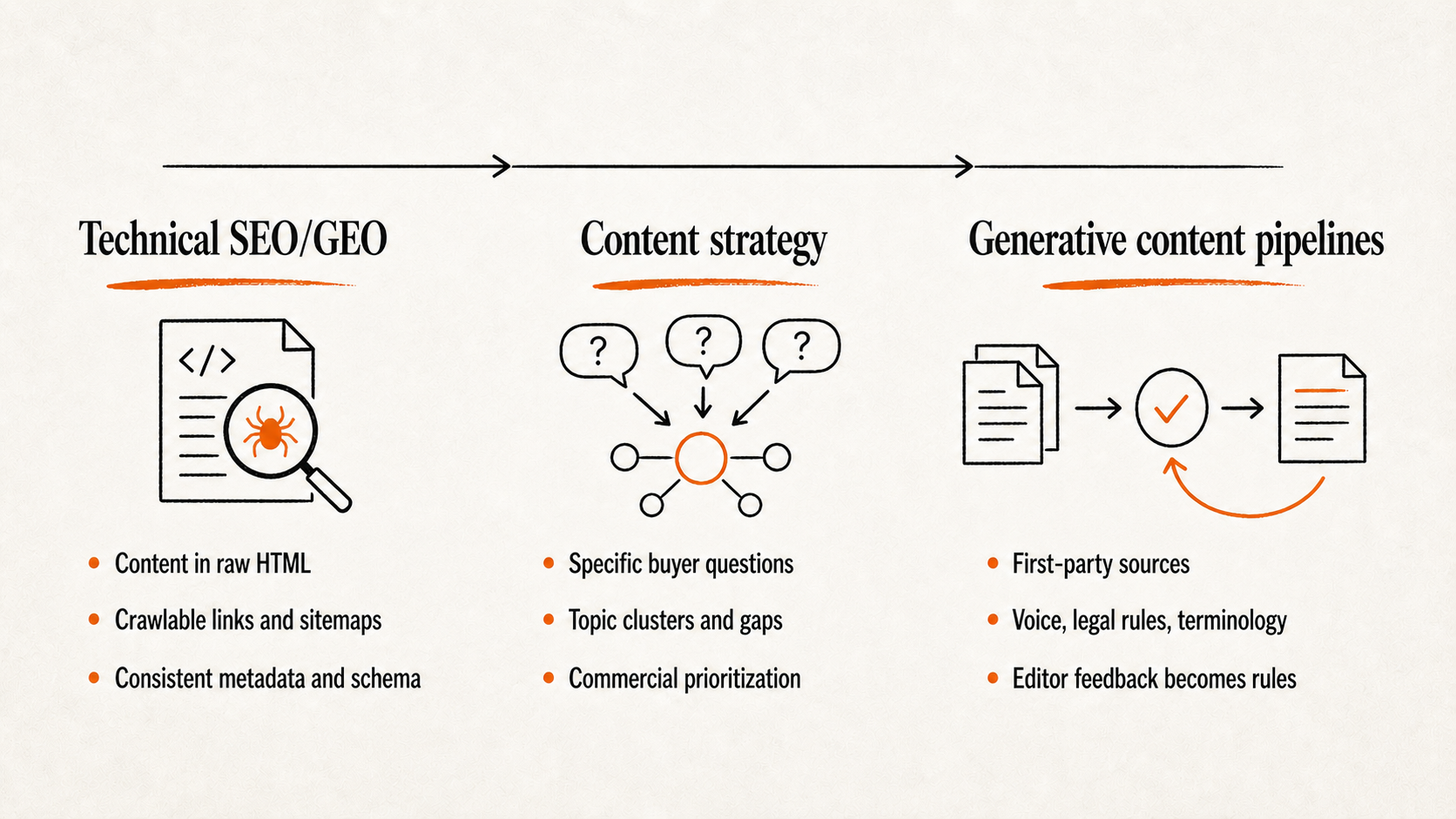
Start with what crawlers receive
A page looking complete in a browser proves little. Browsers assemble pages from HTML, JavaScript, APIs, consent tools, and product databases. Crawlers do not always execute that sequence.
In a recent audit of an e-commerce client, JavaScript withheld body content from roughly 8,000 pages. The same audit found 4,266 indexable pages missing from sitemaps, 1,176 broken internal targets, and 2,352 pages missing their intended structured-data type.
Publishing more articles on those templates would have multiplied the problem. We fixed rendering, internal links, metadata, and language declarations, then tested the released pages again.
In two months, their AI Overview citations increased by 189%, weekly non-branded organic traffic by 138%, and top-three Google keywords by 113%.
The practical lesson is: inspect the raw response, rendered page, internal links, canonical, robots directives, sitemap membership, and structured data for every important template. Use e.g. Screaming Frog’s HTTP crawl for that. Repeat the test after release.
Decide what deserves a page
Once crawlers can retrieve the content, research should decide what gets produced. Keyword volume alone is not enough. We combine traditional demand with buyer questions, search intent, related queries generated during AI retrieval, competing pages, cited sources, and existing content overlap.
The output is a page-level decision: create, revise, consolidate, remove, translate, or monitor. Each approved page receives a defined buyer question, commercial purpose, topic boundary, target queries, supporting sources, and relationship to the relevant product.
For the multilingual financial company, broad articles about cryptocurrency would have wasted the early production budget as AI already answers most of the general informational queries.
Buyers first needed specific answers about legal cryptocurrency purchase in the target country, bank funding, verification, fees, supported assets, custody, exchange, and transfers. Those questions sit closer to a buying decision and depend on facts the company can prove.
Build the evidence before drafting
Good production starts with a sourcing input information. Collect approved product facts, expert interviews, terminology, claims, legal constraints, examples, and editorial rules before generating copy.
We separate semantic quality from linguistic quality. Semantic review asks whether the page answers the right question with the right facts and commercial context. Linguistic review asks whether the wording, terminology, and local phrasing are correct.
For multilingual work, we stabilize the source article first. A language specialist then reviews the localized version. Every substantive correction becomes a production rule, terminology entry, or automated check. The system should stop repeating an error after a person has corrected it once.
Human review remains necessary for original insight, sensitive claims, local language, and final approval. Automation handles repeatable work: source checks, required fields, terminology, duplication, structure, formatting, and known editorial rules.
Measure the whole chain
To understand what’s happening and what you can influence, you need to track both business metrics and technical metrics for both technical SEO and content production. Track the following list:
- Eligibility: Can crawlers discover, retrieve, interpret, and index the page?
- Coverage: Does it answer the intended buyer questions without duplicating another page?
- Visibility: Does it earn rankings, AI citations, qualified impressions, and visits?
- Commercial impact: Does that traffic produce verification, leads, purchases, or revenue?
The measurements should feed the next production cycle. Improve pages that earn relevant visibility but fail to convert. Consolidate pages competing for the same demand. Expand topics that attract qualified buyers. Stop producing formats that create neither visibility nor commercial movement.
For AI visibility, repeat a fixed set of commercial questions. Record the platform, date, answer, citation, and accuracy. Repeated observations reveal whether the company appears consistently.
Google and AI search do not require two content strategies. They require one controlled system connecting technical access, buyer demand, company evidence, production quality, and measurable results across repeated production cycles.
By Eugene Tartakovsky, Founder and CEO/CTO of BeRelevant.ai