


Building a Citation Flywheel: How Earned Sources Shape AI Visibility and Buyer Trust
Author: Mark Huntley
For years, digital authority was measured largely by rankings, backlinks, and traffic. Those signals still matter, but the way buyers discover and evaluate brands is changing.
Search is becoming answer-driven. Prospects are increasingly asking Google, ChatGPT, Gemini, Perplexity, and other AI platforms which companies they should trust, compare, or consider. In that environment, brands are no longer competing only for a position on a search results page. They are competing to become part of the answer.
That requires a different strategy.
Brands do not earn lasting AI visibility simply by publishing more content about themselves. They earn it by becoming consistently referenced across the independent sources that buyers, search engines, and language models already trust.
This is the foundation of a citation flywheel.
What Is a Citation Flywheel?
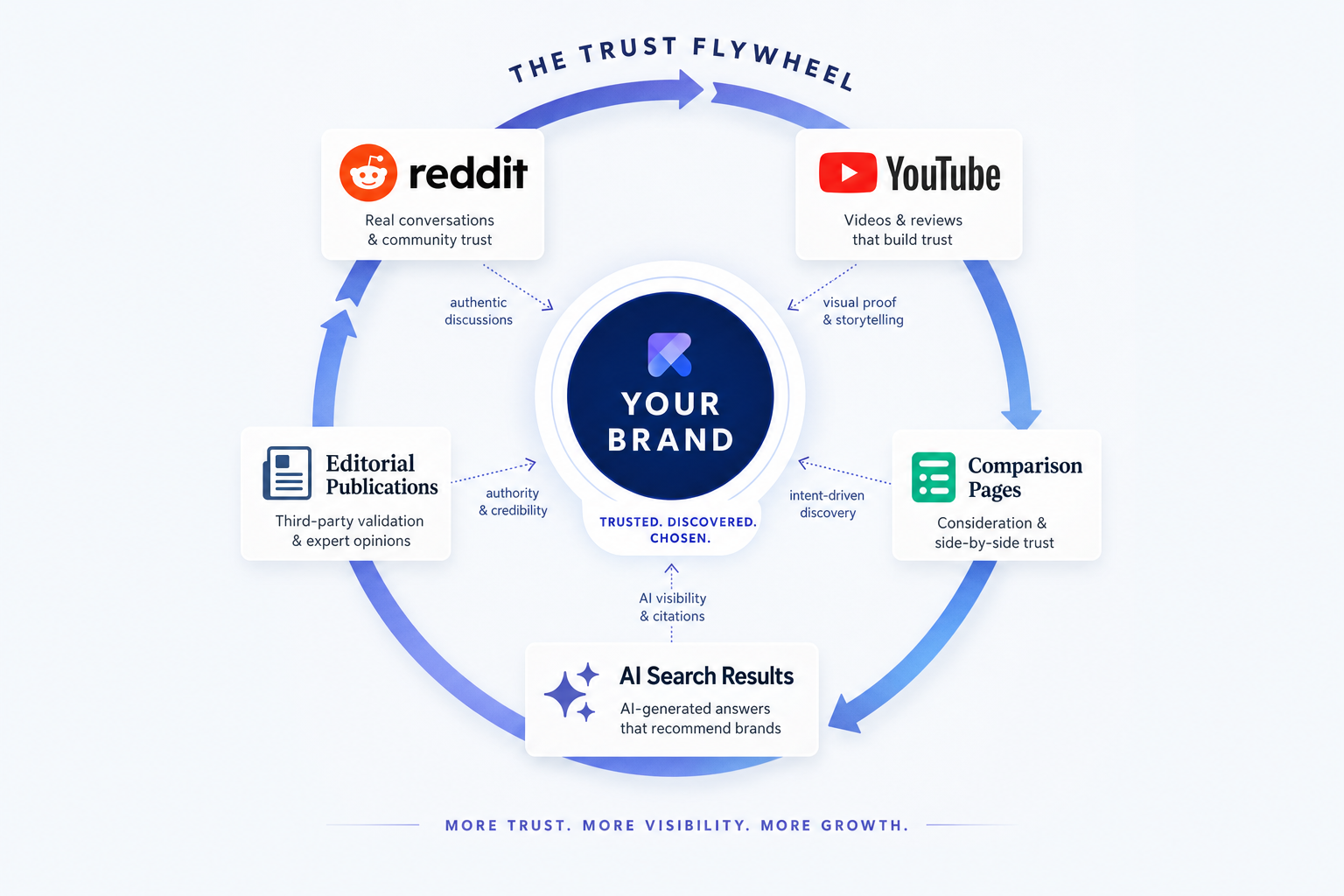
A citation flywheel is the compounding effect created when credible third-party sources repeatedly validate a brand’s expertise, relevance, and reputation.
It begins with useful, contextually relevant mentions across platforms such as industry publications, Reddit discussions, YouTube videos, expert commentary, comparison pages, and other trusted communities.
Those mentions can then influence:
- what appears in traditional search results;
- what buyers encounter during their research;
- how a brand is described by third parties;
- and whether AI systems associate that brand with a particular category or recommendation.
Each credible reference strengthens the broader evidence environment around the brand. Over time, that evidence can lead to more discovery, more branded searches, more discussion, and more opportunities to be mentioned again.
The result is a flywheel rather than a one-time campaign.
Why Owned Content Is No Longer Enough
Most brands are still approaching AI visibility as an extension of conventional SEO. They are adding FAQ sections, improving schema, refreshing service pages, and publishing more articles.
Those activities can help, but they are only one part of the picture.
A company can claim to be the best provider in its category on its own website. That does not make the claim independently credible. Buyers—and increasingly AI systems—look for corroboration.
They want to see whether the brand is discussed by customers, recommended in communities, referenced by experts, included in comparisons, and associated with meaningful subject-matter expertise.
In other words, authority is no longer built only on the brand’s domain. It is built across the wider information ecosystem.
What We Have Seen in Practice
In our work, some of the most valuable visibility has come from sources that traditional link-building campaigns often overlook.
For example, a well-positioned Reddit discussion can rank prominently for a high-intent search and become part of the research journey for months or even years. Its value is not limited to referral traffic. It can influence how buyers frame their options and which brands they investigate next.
We have also seen YouTube content strengthen brand recognition by explaining a company’s value in a format that is easier to discover, reference, and summarize. When the same brand is then mentioned across additional credible sources, the message becomes more consistent and more defensible.
The broader lesson is that a single mention rarely transforms brand authority. Repeated, credible attribution across multiple trusted environments is what creates momentum.
How to Build the Flywheel
The first step is to identify the sources already shaping opinions in your category. Search the questions your buyers ask and study which publications, communities, videos, and comparison pages repeatedly appear.
The second step is to contribute information that improves those conversations. That may include original data, expert commentary, practical examples, customer insights, or a clearer explanation of a difficult topic.
The third step is to measure more than rankings. Track whether the brand is increasingly mentioned in AI-generated answers, category comparisons, community discussions, and high-intent search results.
A useful question is not simply, “Where do we rank?”
It is, “How often are we included when buyers and AI systems evaluate our category?”
The Future of Digital Authority
The next era of brand visibility will be shaped by corroboration.
Companies that rely entirely on self-published claims may struggle to stand out in answer-driven discovery. Companies that build a strong network of earned references will be easier to verify, easier to trust, and more likely to be included in the answers that influence purchasing decisions.
Traditional agencies build links to a brand.
The more strategic approach is to build the evidence environment around it.
Author: Mark Huntley, J.D., CEO, CiteWorks Studios