

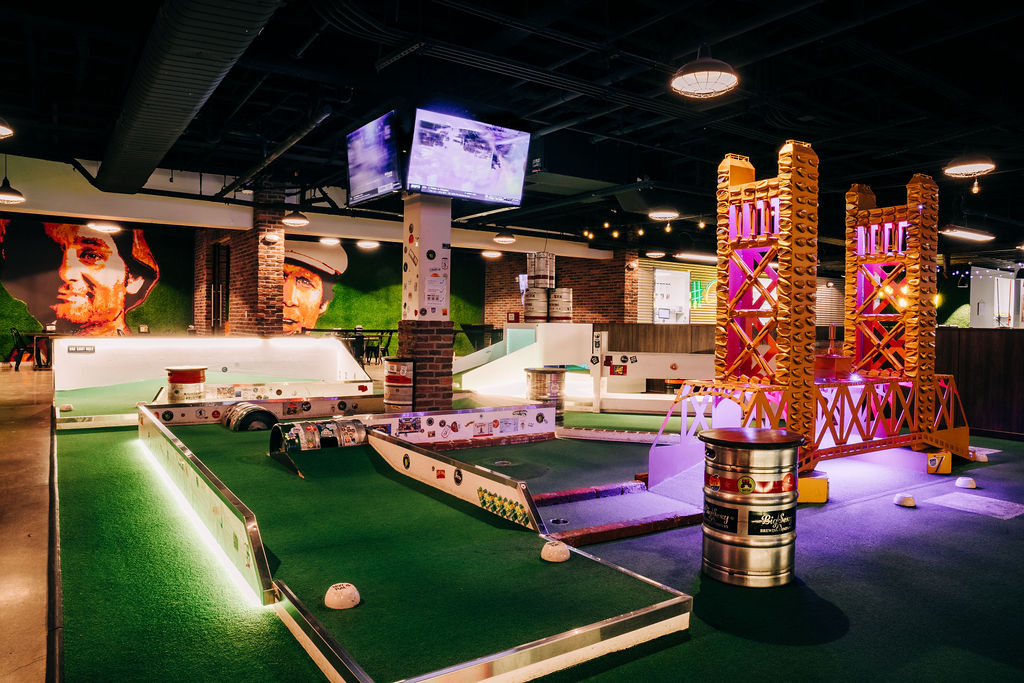
This interview is with Brandon Robinson, FOUNDER / CEO, Tipsy Putt.
To kick us off, how do you introduce yourself as Founder/CEO of Tipsy Putt and describe where the business stands today?
I am a serial founder of businesses, including my most recent ventures: Tipsy Putt, an indoor mini-golf bar, and Trophy Club, a craft cocktail lounge.
Multiple locations throughout Northern California:
- South Lake Tahoe
- Sacramento
- Emeryville
- Monterey
- San Francisco (coming soon)
$10mm-100mm in revenue.
Previously, I was the founder of Skin Body Soul MedSpa, the world’s first multi-state, membership-based medical spa, with locations in Texas, Oregon, Washington, Iowa, and Minnesota.
How did your path from building and exiting a multi-state medspa to hospitality shape the way you lead and scale an indoor mini-golf eatertainment brand?
For me, it’s all about hiring and empowering your team. We learned to build an incredible culture and to develop managers with autonomy at Skin Body Soul. We carried that experience over to Tipsy Putt.
We listen to our managers and allow them to get creative when necessary. By doing so, we create incredible problem solvers. That is truly the key to success.
Building on that, what is one guest-experience design choice—on the course, in the bar, or in the guest flow—that most increased revenue per guest at Tipsy Putt?
Throughput is incredibly important in all businesses; it is the single most important component in a high-volume restaurant.
Friction creates challenges. We have streamlined our offerings, pricing, and menus to create the least amount of friction in the customer journey. This has increased our revenues and improved the guest experience at all of our locations.
Shifting to your local beer program, how do you choose and structure partnerships with breweries in each city to stay hyper-local while protecting pour costs and margins?
One of the most challenging items we’ve needed to tackle, especially in the current inflationary environment, is maintaining a strong relationship with our breweries and being extremely candid with them. Getting creative and thinking outside the box—such as white-labeling products or placing larger orders—has helped us drive down pricing. Ordering entire batches ahead allows brewers to limit inventory and maximize their throughput while giving us a better price. This, in turn, allows us to protect our margins.
Looking at expansion, what single site-selection metric has been most predictive of a profitable Tipsy Putt before you sign a lease?
I wish there were one “magic wand” answer to this. It’s a combination of market rents, location, size, and buildout costs. It’s a large math problem. But we think we have the winning formula.
On the CEO side, what weekly operating rhythm or dashboard keeps four locations aligned and empowered without slowing down your general managers?
Consistency: reporting, setting benchmarks, holding team members accountable, and measuring those benchmarks weekly during roundtable discussions.
From a marketing and PR perspective, what one campaign—or a video you cut in Final Cut Pro—proved most effective at filling the tee sheet?
It’s not what we’ve shot; it’s what others have filmed and created.
It’s best not to talk about yourself. It’s best to have others do the talking for you.
Turning to capital strategy, why did you choose Regulation CF crowdfunding for your San Francisco location?
We live by our values: Community, Fun, Golf, Competition, and Local.
By doing CF crowdfunding, we engaged directly with the local San Francisco community and promoted it prior to our opening.
We want the community to be a part of the story.
For founders aiming to pair games with craft beer, what is one hard-won lesson you wish you’d known before your first build-out?
Operating any business, especially in California, has become incredibly expensive. Any founder who wants to venture into this business should be extremely careful with their floor plan and build from the inside out: operationally first, then aesthetically second.
Make sure you can operate with fewer people without sacrificing the customer experience.