


Your Company Is Using AI to Understand Customers. But You’re Only Getting Half the Picture.
Authored by: Diana Villalobos
Most companies I have worked with can tell you exactly what their customers are doing. The know where their customers have drop off. What they click. Which segment converts. They have dashboards, AI-generated summaries, pattern analyses across thousands of data points.
What they struggle to answer is why.
That gap, between what AI surfaces and what customers actually mean, is where decisions start to go wrong.
Adoption is already the norm. Scrutiny isn’t.
Based on a survey we conducted in June 2026 with 130 Canadian managers and senior professionals, 85.4% said their company already uses AI in some form to understand customers. The most common applications: personalizing the customer experience, analyzing customer feedback, and identifying patterns in customer behavior.
These are all quantitative tasks. AI is being used to process, aggregate, and summarize data that already exists. Useful, yes. But only one layer of customer understanding.
When we asked how much those same managers trust AI-generated insights compared to direct customer research, only 18.5% said they trust AI more. 37.7% trust direct research more. Yet most are acting on AI insights regardless.
That’s not a trust gap. It’s a criteria gap. Companies are using AI without a clear sense of when it’s enough and when it isn’t.
What AI can’t tell you
AI can tell you that 35% of customers abandon your onboarding flow at step three. It can flag that satisfaction scores dropped after a product update. What it cannot tell you is what the customer was thinking at step three, or what specifically changed after the update. That context lives in conversations, not in datasets.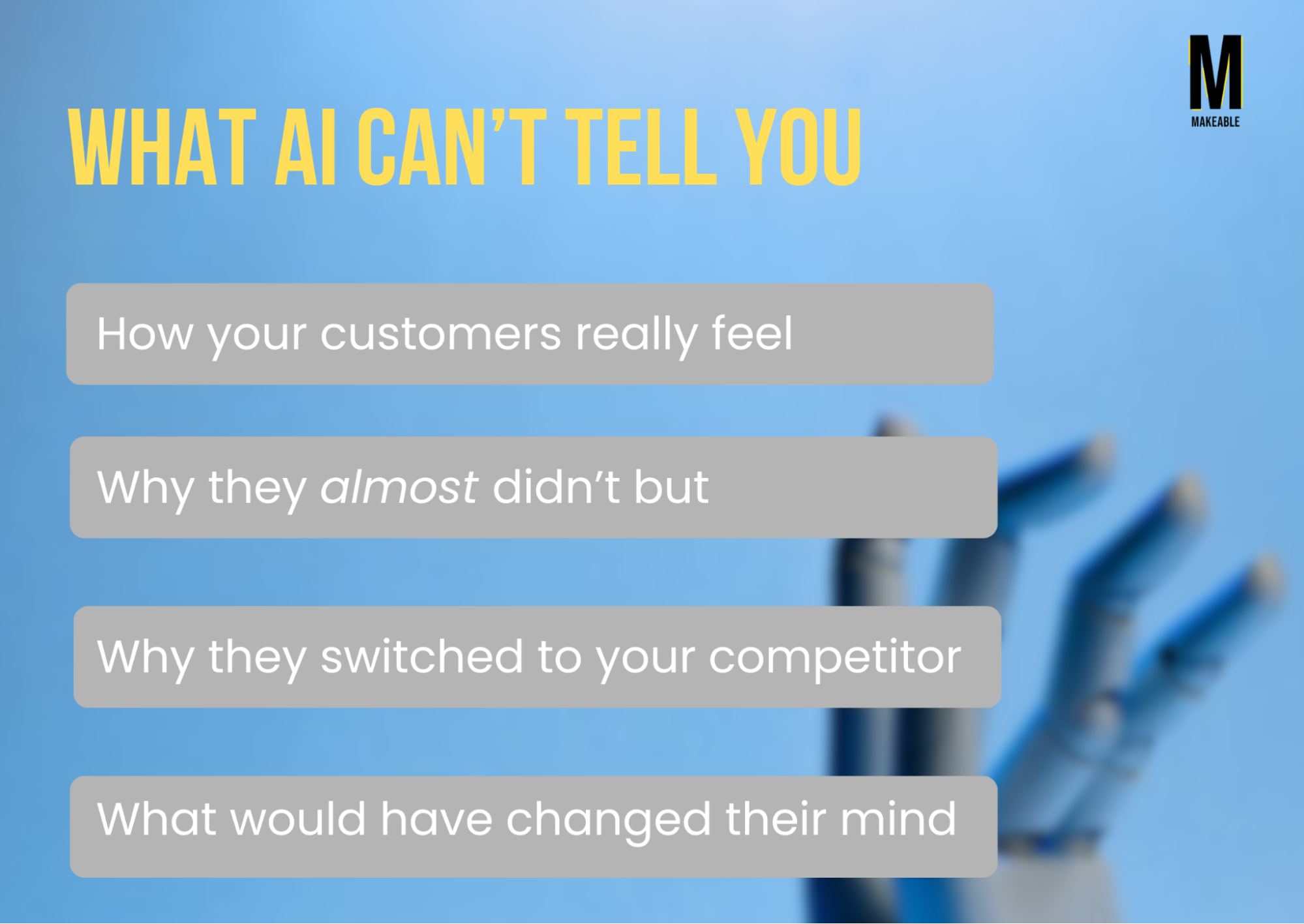
A 59-year-old male Associate framed the balance well:
“Nothing replaces human interactions or experiences, but AI may offer different views or options never thought of.”
That’s exactly the right mental model: AI as a starting point, not a conclusion.
So what do you actually do about it?
If you recognize your company in this pattern, relying heavily on AI-generated insights without a qualitative layer, here’s where to start.
- Audit before you act. Before implementing any AI-generated recommendation, ask one question: do you know why this pattern exists? If you can’t answer that, you don’t have enough information to act.
- Add the “why” to what you already have. You don’t need a full research program to start. A single open-ended question added to your next NPS or CSAT survey, something as simple as “why did you give that score?”, gives you qualitative context that no AI tool can generate on its own.
- Talk to five customers. This is the recommendation most companies resist, and the one that consistently delivers the most value. Five well-conducted interviews tell you more than a thousand rows of behavioral data. They don’t need to be long. Thirty minutes with a current customer, a churned customer, or a customer who almost didn’t convert will surface motivations, frustrations, and context that no dashboard will ever show you.
- Don’t dismiss focus groups as too expensive or too slow. Four to five people in a 90-minute session can reveal behavioral patterns and emotional drivers that quantitative data can only hint at. Done right, a small focus group is neither a major budget item nor a six-month commitment. The barrier is usually not cost or time. It’s not knowing where to start.
The takeaway
AI handles volume. It tells you what is happening across thousands of customers faster than any team can. But the decisions that matter, the ones that affect retention, experience, and growth, require understanding why. And that understanding still comes from talking to actual people.
The most effective customer insights programs use both. AI to identify where to look. Qualitative research, whether interviews, focus groups, or open-ended questions, to understand what you’re actually looking at.
That combination produces decisions you can defend, not just data you can report.
This article draws on findings from the AI Trust Gap Study, a survey of 130 managers and senior professionals at Canadian companies conducted in June 2026. Full results available at makeableconsulting.com/ai-trust-gap-study.
Bio: Diana Villalobos is the founder of Makeable Consulting, a customer insights consultancy helping growing Canadian businesses build the research infrastructure to make better decisions. She has 15 years of experience in customer research across FinTech & Banking, Retail, Foodservice, Education and research agencies.