

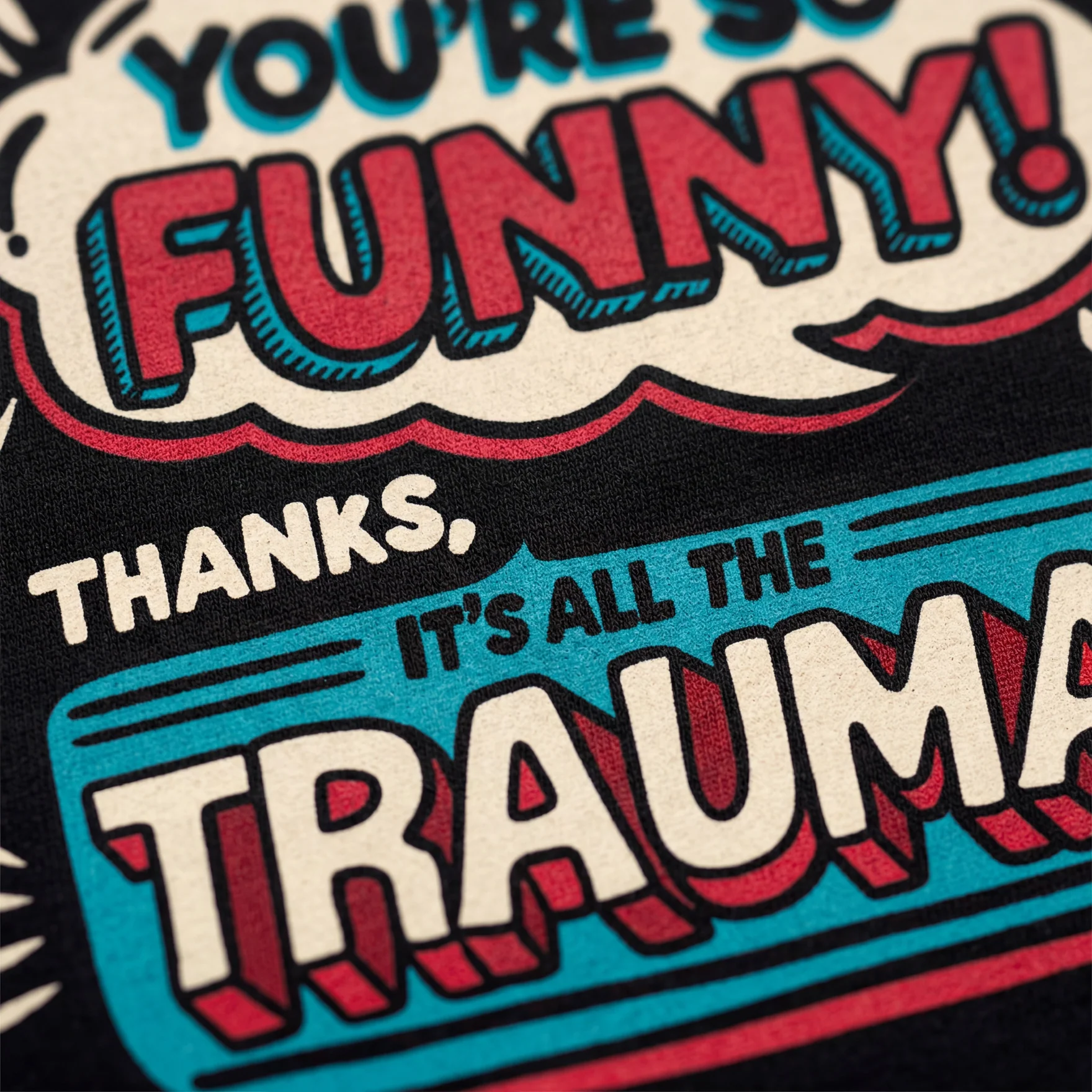
Why Humor Is a Valid Coping Mechanism (And Why the Trauma Made Me Funny)
Authored by: Alyssa Ostroff
I want to start with a disclaimer: I am genuinely hilarious.
I know that’s not something you’re supposed to say about yourself. But I’ve earned it. And by the end of this article, you’ll understand why.
The Four Types of Coping Mechanisms (And Where Humor Lives)
Psychologists generally recognize four main categories of coping:
Problem-focused coping targets the source of stress directly — problem solving, planning, time management, boundary setting.
Meaning-focused coping uses cognitive strategies to find purpose or silver linings — reframing a situation, locating the growth inside the grief.
Social coping is support-seeking — reaching out for emotional comfort, advice, or just someone to sit with you while things are hard.
Emotion-focused coping aims to reduce negative emotional responses associated with stress. This is where you find meditation, journaling, reframing — and my personal favorite: humor.
So yes. Humor is a clinically recognized coping mechanism. It lives in the same category as meditation. You’re welcome.
What Humor Actually Does to Your Brain
This isn’t just feel-good logic. Humor has real physiological effects.
It lowers cortisol — your body’s primary stress hormone. It releases endorphins. It enhances mood. It gives you a momentary step back from whatever you’re in the middle of, like taking a deep breath and actually exhaling.
Finding humor in a hard situation lets you see it more clearly. It creates a tiny bit of distance between you and the pain — enough to breathe, enough to keep going. Sometimes that temporary escape is all you need.
The Dinner Table
Here’s where it gets personal.
Growing up, dinnertime in my house was not exactly a warm Norman Rockwell situation. My parents would pick on me, shame me, put me down — and I learned early that if I played into it, if I made myself the punchline before they could, it hurt less.
My mom used to count how many times I said “like” when I talked. One night she announced “47” and my sister chimed in “I got 52.” They’d been counting my “likes” while I told them about my day.
I remember being taken aback for about two seconds. And then I said: “Oh my gosh, that’s like crazy. So like, I—” and I leaned into it completely. Fed the joke. Made it absurd. They were annoyed. But I wasn’t crying. And that was the point.
The harder truth is that humor wasn’t just self-protection — it was protection for my siblings too. When my parents would fight and chaos ran through the house, I would pull my siblings aside and start making jokes to keep things light. If my dad was screaming at one of my sisters at the dinner table, I would stand up and say something completely absurd — “And that’s how I found out I was pregnant” — and everyone would turn to look at me instead.
I could take it. I was the oldest. And I was armed with the only weapon I had: a willingness to be ridiculous at exactly the right moment.
It wasn’t until ninth grade, studying Shakespeare, that I learned “comic relief” was an actual literary device. I thought: oh. I’ve been doing that my whole life.
The Correlation Nobody Talks About
The more I learn about my favorite comedians’ lives, the darker their childhoods tend to be. The harder the road, the sharper the wit.
Because if you didn’t laugh, you would cry. And in some houses, there was already so much crying that you didn’t want to add to it. So you made a joke instead. And then another. And eventually someone tells you you’re funny, and you realize you’ve accidentally developed a skill out of pure survival instinct.
My dad told me growing up that I had a horrible personality and nobody liked to be around me.
I am one of the funniest people I know.
So thanks, Dad. You did something right. Accidentally. But still.
Humor Doesn’t Replace Therapy. But It Helps.
Humor is a valid coping mechanism — but it’s not a substitute for doing the actual work. I go to therapy. I take my medication. I feel my feelings, even the ones that don’t have punchlines.
But in the moments when you can’t control what’s happening, when all you can do is sit inside the chaos and keep breathing — sometimes the most resilient thing you can do is find the absurdity and laugh.
It’s emotional regulation. A way to reclaim a tiny bit of control. A way to connect with other people who are also laughing through their pain — which, as it turns out, is a lot of us.
If you use humor as a coping mechanism, if your jokes are a little dark, if people sometimes don’t know whether to laugh or be concerned — you’re not broken. You’re coping.
And if you ever need more than a laugh, 988 is always there. You don’t have to carry it alone. 🖤
About the Author Alyssa Ostroff is a graphic designer, mental health advocate, trauma survivor, and founder of Self-Care Shirts — a mental health awareness apparel brand where every design is hand-drawn and 10% of proceeds are donated to 988 and The Trevor Project. She spent five years as a Senior Graphic Designer at the CDC before launching Self-Care Shirts on May 1, 2025.