

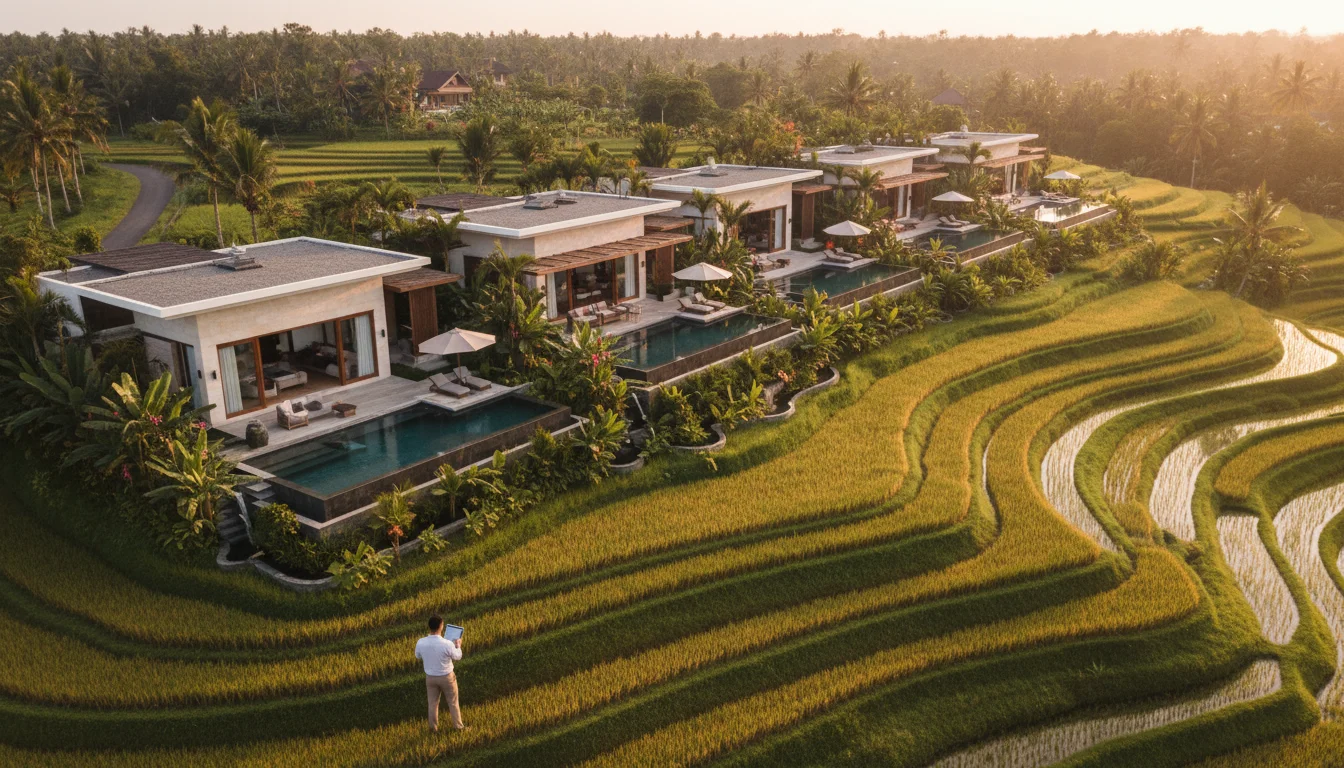
This interview is with Stanislav Sadovnikov, Founder, Magnum Estate.
What key experiences shaped your path from construction and marketing strategy to leading high-end villa and resort developments across Bali?
Two very different schools shaped me, and I am grateful for both.
Construction taught me respect for reality. On a site, nothing forgives wishful thinking. Concrete, timelines, budgets, and people all push back, and you learn quickly that a beautiful idea means nothing if it cannot be built well and on time. That is where I developed my obsession with quality and my habit of checking things with my own eyes instead of trusting a nice presentation.
Marketing taught me the opposite lesson, which is that a building is never just a building. It is a promise about how someone wants to live. Strategy work forced me to think about the buyer first, to understand what they really feel and fear before they sign, and to build a brand people trust rather than just a product they compare on price.
When I arrived in Bali, I saw a market full of energy but short on that combination. Plenty of people could sell a dream, and plenty could pour concrete, but very few could do both and stand behind the result for years. That gap became Magnum.
So my path was not a straight line. It was learning to build honestly, learning to speak to people honestly, and then refusing to choose between the two. High-end villas and resorts are exactly where those two skills finally had to meet.
Building on that, from your work delivering legally titled villas, what is the one due-diligence step you insist buyers complete before committing in Bali?
If I could force every buyer in Bali to do one thing, it would be this. Before you fall in love with a villa, verify the land certificate itself, independently, at the source.
That means taking the certificate to the local land office, the BPN, with your own notary and confirming three things:
- That the land really exists as described.
- That the person selling it is truly the registered owner.
- That the zoning actually allows what you want to do there.
So many problems in Bali come from beautiful villas sitting on land that was never zoned for tourism or residential use, or land where the paperwork quietly does not match reality.
People get emotional here. The view, the pool, the lifestyle — it all pulls at you, and it is easy to trust a smile and a nice brochure. But a certificate that has not been checked at the source is just a piece of paper with a promise on it.
This is exactly why we deliver legally titled villas and why we welcome this kind of scrutiny instead of fearing it. A serious developer wants you to check. If anyone rushes you past this step or tells you it is not necessary, that is your answer. Walk away.
Do the boring verification first. It is the one hour that protects everything that comes after.
Zooming into Canggu, what single site attribute has most consistently predicted outsized long-term value for you there?
In Canggu, the single attribute I trust most is access, not the view. Specifically, how easy it is to reach the property on a real road, and how close it sits to the things people actually use every day.
Everyone falls for the rice-field view or the beach distance on paper. But Canggu is famous for narrow lanes, traffic and shortcuts that flood in the rainy season. A villa that looks perfect can quietly lose value because guests hate the twenty-minute crawl to reach it. Land that sits on a proper access road, close to the cafes, the beach clubs and the main arteries, keeps performing year after year no matter how the area changes around it.
I have watched this play out again and again. Two plots, similar price, similar look. Five years later the one with clean access has climbed in both rental demand and resale value, while the hidden one struggles to fill its calendar.
Access is also the thing you cannot fix later. You can renovate a villa, restyle a pool, rebrand a project. You cannot move the land closer to the road. So when I judge a Canggu site, I stand at the entrance and ask one question: Would a tired traveler with luggage smile or sigh when they arrive here? That answer has predicted long-term value for me better than anything else.
On the commercial side, when you integrate retail or F&B into a luxury villa or resort development, what underwriting framework do you use to validate viability?
My rule is simple: I never underwrite retail or F&B on the dream of what it could earn. I underwrite it on what it must earn to justify the space it takes, and then I stress that number until it hurts.
The framework has three layers:
-
Demand. I split the audience into captive and external. Captive is the guests and residents who are already on site, and I am honest that they only spend a certain amount per day. External is the people we have to pull in from the neighborhood, and that is always harder than the pitch deck says. If a concept only works when strangers show up in big numbers, I treat it as fragile.
-
Rent-to-revenue ratio. A healthy F&B tenant should carry occupancy costs at a level that leaves them alive in a slow season, not just in a good month. If my rent needs their best case to work, the deal is already broken.
-
Downside. I model the quiet version: rainy season, lower occupancy, a soft year for tourism. If the space still washes its own costs in that world, it belongs in the project. If it only shines in the optimistic case, it becomes a liability that drags on the whole asset.
And above all, the operator: a brilliant location with a weak operator fails. I would rather give great space to a proven team than chase a trendy brand that cannot run a real kitchen.
From a construction and project management lens, which early design or procurement decision has delivered the highest ROI for build quality and schedule reliability in Bali’s climate?
The highest-return decision we make happens long before anyone pours concrete: committing early to real waterproofing and drainage designed and procured as a serious system, not treated as a finishing detail at the end.
Bali’s climate is beautiful and brutal: heavy rain, salt air, and humidity that never really leaves. In that environment, water is the enemy of every building. Most quality problems people blame on bad workmanship actually start as small water issues that were ignored: leaks, damp, mold, rusting fixings, and cracked finishes. Fix that at the source and half your future headaches simply never appear.
So we lock in the roofing, membranes, drainage, and materials early, and we buy them from proven suppliers rather than whatever is cheapest that week. That single choice protects build quality for years and it protects the schedule too, because rework is the biggest silent killer of timelines here. Tearing out finished walls to chase a leak costs you weeks you can never win back.
Early procurement of the right materials also shields us from the other local risk, which is supply. When you decide late, you are at the mercy of what happens to be on the island. When you decide early, you control quality, price, and delivery.
Boring decisions made early quietly outperform every clever idea added late.
Turning to luxury brand marketing, which messaging angle has most reliably converted serious estate inquiries into on-site visits from international buyers?
The angle that converts best is not luxury; it is proof and safety. Serious international buyers are not short of beautiful pictures. What they lack is a reason to believe they will not get burned when buying property far from home.
So the message that reliably turns an inquiry into a visit is some version of this: real, finished, legally titled, and already earning. Not renders, not promises, but buildings people can walk through, certificates they can verify, and returns that are actually landing in owners’ accounts. The moment a buyer feels the risk drop, the trip suddenly makes sense.
I have watched this again and again. Pure lifestyle messaging fills the top of the funnel with dreamers. It gets likes. But the people who book a flight and show up on site are the ones who were reassured, not just excited. They want to know who stands behind the project, what happens if something goes wrong, and whether the numbers survive a hard look.
So we lead with track record and transparency, then let the lifestyle do the closing once they are here. Bali sells itself in person. My job in the message is only to earn the visit, and trust earns the visit far more reliably than glamour.
The quiet truth of luxury marketing at this level is that the strongest emotion you can sell is not desire; it is confidence.
On the customer service front, what specific information do you wish every estate inquiry included so your team can respond with a precise, investor-grade proposal?
Honestly, I wish every inquiry started with the buyer’s real goal, stated plainly. Most people write to ask about a villa. What I actually need to know is why they are buying at all.
Three things would let my team answer with a precise, investor-grade proposal instead of a generic one:
- Objective. Are you buying to earn rental yield, to hold for capital growth, to use it yourself part of the year, or some mix? That single answer changes which project, which location and which unit I would even show you.
- Budget and the structure. The real number you are comfortable with, whether it is cash or staged payments, and your time horizon for holding.
- Your situation as a buyer. Where you are based, whether you have bought abroad before, and how hands on or hands off you want to be with management.
With those three things I can come back with actual figures, a realistic yield range, the ownership path that fits your case, and a shortlist that respects your money instead of wasting your time.
Without them we are forced to guess, and guessing produces those polite, useless brochures that impress no one. The buyers who share their real goal always get the sharpest answer, because they let us treat them as an investor, not a lead.
Looking ahead 12–24 months, what timing or location move would you make today if you were a first-time international investor in Bali seeking both lifestyle value and yield?
If I were a first-time international investor today, I would stop chasing the last hot spot and move one step ahead of the crowd. In the next twelve to twenty-four months, the easy money in the most crowded parts of Canggu is gone. Prices there already reflect the hype. The smarter play is to focus on areas that are maturing but not yet saturated.
That is why I would look seriously at Uluwatu and the wider Bukit, and Sanur. Uluwatu has the drama, the surf and the new attention, and it still has room to grow as infrastructure catches up. Sanur is the quieter compounder — calmer, more established, with a stable long-stay crowd and a new gateway opening up the whole east of the island. Both give you real lifestyle today and yield that is not already priced to the ceiling.
On timing, I would move before completion rather than after. Buying into a credible project at an early phase, from a developer with a real track record, is where the best entry prices still live. You trade a little patience for a better number.
And I would keep it boring on the fundamentals:
- Legally titled land
- Proven developer
- Clean access
- A unit that rents easily
Get those right in a rising area and the lifestyle takes care of itself while the value builds underneath you.
Thanks for sharing your knowledge and expertise. Is there anything else you'd like to add?
Just a thank you and one thought Id leave your readers with.
Bali is often sold as a fantasy, and that is exactly why people get hurt here. My whole approach, and the reason we built Magnum the way we did, is to prove that the dream and the discipline can live in the same place. You really can have the sunset, the pool and the lifestyle, and also own something legally clean that earns real money. You should never accept one without the other.
So if you take anything from this conversation, let it be this. Slow down at the boring parts. Check the certificate. Ask who stands behind the project and what happens if something goes wrong. Judge a developer by what they have already finished, not by what they promise. The people who do this quiet homework are the ones who end up genuinely happy in Bali, years later.
We are still early in what this island can become, and I feel lucky to be building in it. My goal is simple. When someone thinks about premium property in Southeast Asia, I want the first name that comes to mind to be one they can trust completely.
Thank you for having me, and to anyone reading, my door is open if you ever want to talk honestly about doing this the right way.