

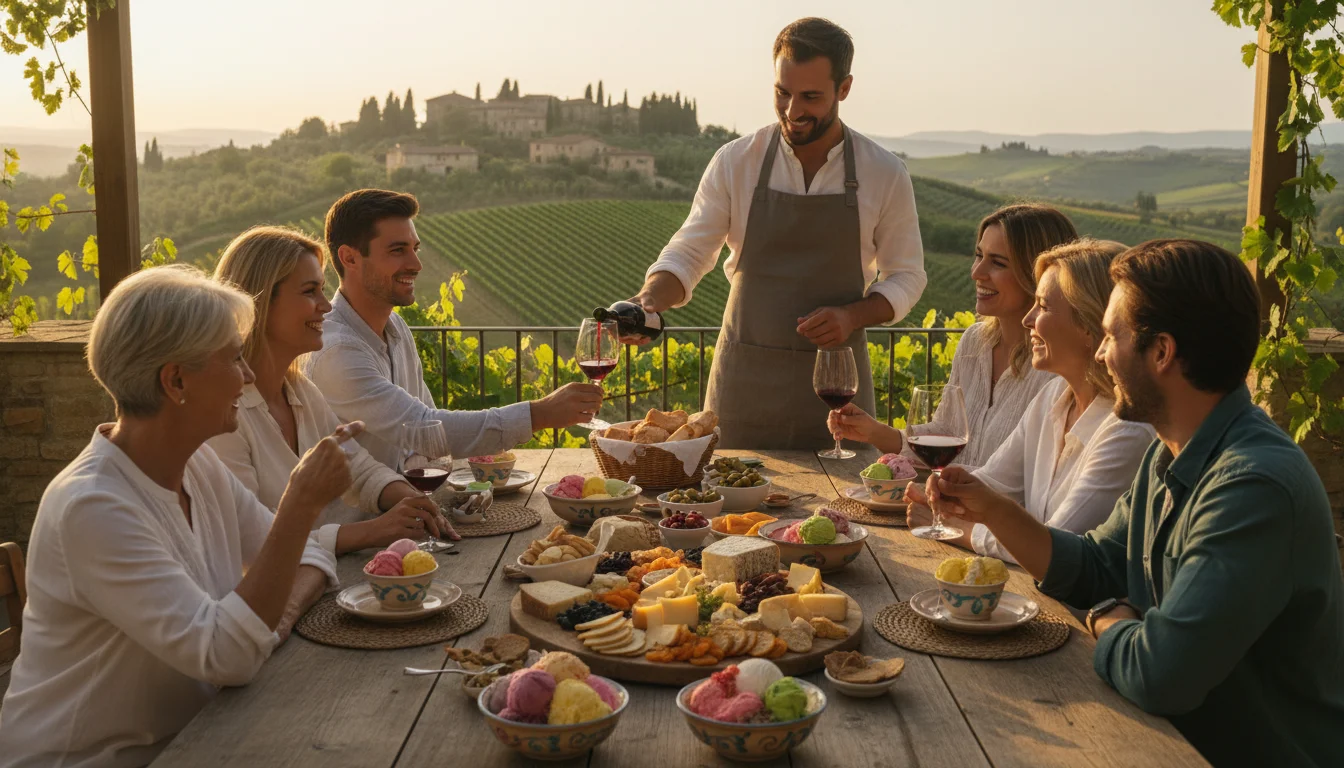
This interview is with Luciano Armanasco, Founder & Tour Host (Italy Tour Operator for U.S. Travelers), Our Dolce Vita.
To start, as Founder & Tour Host of Our Dolce Vita, how do you introduce your niche and expertise to U.S. travelers discovering you for the first time?
In my case, the niche is not just “Italy travel.” It is guided, all-inclusive Italy travel designed for U.S. travelers who want the beauty of Italy without the stress of having to figure out every moving part on their own.
What I usually explain first is that Our Dolce Vita is built around a different idea of convenience. We are not selling a generic package where travelers are left to connect the dots once they arrive. We focus on curated, hosted trips where the experience is designed from arrival to departure, with logistics, local rhythm, meals, excursions, and on-the-ground support already thought through.
My expertise comes from being Italy-based and from knowing how American travelers actually experience the country, not just how it looks in a brochure. A lot of first-time visitors underestimate distances, transitions, transport friction, and the difference between seeing Italy and moving through it well. That is where I believe my perspective becomes useful.
So if I had to introduce my niche simply, I would say this: I help U.S. travelers experience Italy in a more complete, less stressful, and more meaningful way through guided, all-inclusive journeys that are designed with real local knowledge, not just surface-level sightseeing.
What pivotal experience set you on the path to founding Our Dolce Vita and to the way you host Italy tours today?
The pivotal experience was realizing that many U.S. travelers were not actually struggling with whether Italy was worth visiting; they were struggling with how to experience it well.
Over time, I kept seeing the same pattern. People were excited about Italy, but once the trip became real they started running into the same issues: unrealistic itineraries, too many transitions, transport stress, language barriers, and the pressure of trying to make every decision correctly in a country they did not know well. I saw how easily a beautiful trip could become fragmented or tiring simply because too much was left for the traveler to manage alone.
That is what pushed me toward building Our Dolce Vita. I wanted to create a more complete way for Americans to experience Italy—not just a trip they book, but a trip that is hosted, guided, and thoughtfully designed from arrival to departure.
That also shaped the way I host tours today. I do not think only in terms of destinations. I think in terms of rhythm, flow, logistics, atmosphere, and how people actually feel as they move through the country. For me, the goal is not just to show travelers Italy; it is to help them experience it in a way that feels smoother, richer, and far less stressful.
Building on that, when you create a new itinerary, what is the first choice you make to embed an everyday, local rhythm into day one?
The first choice I make is not where to send people first. It is how to make them feel the pace of Italy from the very beginning.
Many travelers arrive with the instinct to maximize. They want to see a lot, move fast, and make the first day feel productive. I usually take the opposite approach. Day one should lower friction, not increase it. That means reducing unnecessary decisions, avoiding overpacked transitions, and giving people an immediate sense of place instead of throwing them into a checklist.
For me, local rhythm starts with how the day flows. The first meals matter. The timing matters. The balance between activity and breathing room matters. Even something as simple as not rushing people straight into a packed sightseeing schedule can completely change the tone of the trip. When travelers feel grounded early, they enjoy everything more afterward.
That is also why I believe well-designed all-inclusive Italy vacation packages can be so valuable. When the structure is right, travelers are free to be more present. They are not spending day one trying to solve logistics. They are starting to absorb the place.
So, the first real choice is always this: create a day that helps people arrive mentally, not just physically. Once that happens, the trip begins to feel more local, more human, and much less performative.
Shifting to wine, what criteria do you use to choose wineries and cellars that feel intimate and genuinely local for U.S. guests?
When I choose wineries and cellars for U.S. guests, I do not start with prestige alone. I start with a feeling.
A winery can be beautiful, respected, and technically excellent, but still not feel personal when guests arrive. What I look for first is whether the experience feels rooted in a place and in the people behind it. I want guests to feel that they are entering a real world, not a polished tasting created only for volume.
That usually means looking for producers or cellars where there is a strong sense of identity, where the story is specific, where the hospitality feels natural, and where the tasting reflects the region rather than trying to imitate an international template. I pay attention to scale, atmosphere, pacing, and whether guests are actually being invited into a local culture or simply processed through a tasting slot.
I also think a lot about emotional texture. American guests often remember the human side of a wine experience just as much as the wine itself. They remember who welcomed them, what they learned, what felt surprising, and whether the experience felt intimate rather than performative.
That perspective is also shaped by the fact that I own Terrae III, a boutique winery with a tasting room in Bellagio. Being directly involved in that world has made me even more sensitive to the difference between a tasting that is simply attractive and one that feels grounded, memorable, and genuinely local.
So in the end, my criteria are not just about wine quality, even though that matters deeply. They are about authenticity, scale, storytelling, warmth, and whether the guest leaves feeling they touched something real.
For cultural touring beyond the headline sights, what single setup detail helps an experience feel deeper than a checklist?
The single setup detail that makes the biggest difference is giving people context before the experience, not just information during it.
A lot of cultural touring stays superficial because travelers arrive at a place with no emotional entry point. They see something beautiful or important, but they have not been given a reason to connect with it yet. When that happens, even remarkable places can turn into a sequence of sights rather than a lived experience.
What I try to do instead is create a bridge before guests arrive. That can be a story, a local perspective, a family detail, a historical tension, or even a very simple explanation of why this place mattered to ordinary people, not just to history books. Once travelers have that frame, they stop moving through a site like spectators and start engaging with it more personally.
For me, depth usually does not come from adding more facts. It comes from shaping the way a person enters the experience. If the setup is right, people slow down, notice more, ask better questions, and remember the place in a much more lasting way.
That is often the difference between cultural travel that feels meaningful and cultural travel that feels like a checklist.
For multi-generational family trips, what single pacing rule has proven most effective to keep kids engaged and adults relaxed?
The single pacing rule that works best is this: never make every part of the day matter equally.
Multi-generational trips usually become stressful when the schedule is built as if every stop has to be important, efficient, and fully enjoyed by everyone. That’s too much pressure for one day. Kids get overstimulated, adults get tired, and small delays start affecting the entire mood.
What works better is giving each day one main anchor: one experience carries the day, and everything else supports it. That immediately creates more breathing room. If lunch runs long, if someone needs a break, or if energy shifts, the day still feels successful because the core moment already exists.
This approach helps kids because they are not being asked to stay “on” all day. It helps adults because they do not feel like they are constantly managing the clock. And it helps the group as a whole because the trip starts to feel paced rather than packed.
In my experience, people remember multi-generational travel more fondly when the day has a clear center and softer edges. That is what keeps kids engaged and adults relaxed at the same time.
When plans change in Italy, what 'Plan B' structure do you rely on to protect travelers’ time and access?
The “Plan B” structure I rely on is simple: I never build a day around only one fragile version of success.
In Italy, plans can change for all kinds of reasons. Weather shifts, transport delays, seasonal closures, strikes, traffic, local timing, or even the pace of the group can force adjustments. If an itinerary is built too tightly, one disruption can start affecting the whole day. That is what I try to avoid.
So my real backup plan starts before the trip even begins. For every major day, I want a primary version, a secondary version, and a lighter fallback that still feels worthwhile. The goal is not just to replace one activity with another. The goal is to protect the traveler’s sense that the day still has value, rhythm, and access to something meaningful.
I also try to keep backups geographically intelligent. A good Plan B should not create more stress than the original plan. It should stay close enough, flow naturally enough, and still fit the mood of the day. If guests lose one experience but gain another that feels coherent, the trip still feels cared for rather than compromised.
For me, that is the real structure: build flexibility before it is needed, keep alternatives close and realistic, and make sure the guest never feels the day has collapsed just because the original version changed.
From your perspective as an on-the-ground host, what small, easily overlooked detail most improves a traveler’s day in Italy?
The small detail that most improves a traveler’s day is reducing decision fatigue before it starts.
Many people imagine that what makes a day in Italy better is adding something extra. In my experience, it is usually the opposite: removing the small frictions that quietly wear people down. These include:
- not knowing where to eat
- not knowing when to leave
- uncertainty about how long a transfer will really take
- not being sure whether a stop is worth it
- not knowing what to do if the plan shifts
When those decisions are simplified, travelers become more present. They notice more, enjoy meals more, move more calmly, and stop feeling like they have to manage the country in real time. That changes the whole emotional tone of the day.
As an on-the-ground host, I have found that the best days are rarely the ones with the most packed schedule. They are the ones where people feel carried a little. They still feel free, but they do not feel alone with every micro-decision.
That is often the overlooked difference between a day that looks good in photos and a day that actually feels good while you are living it.
Looking ahead, which regions or styles of food, wine, and culture are you most excited to introduce to U.S. travelers next?
What excites me most is introducing U.S. travelers to parts of Italy that feel deeply rooted rather than over-explained.
I will always love bringing people to Northern Italy, especially where food, wine, and mountain culture meet. That part of the country has a kind of layered beauty that many travelers do not fully expect. You have alpine identity, lake life, serious wines, strong regional food traditions, and a rhythm that feels very different from the version of Italy most people first imagine.
I am also always excited by experiences that show how different one part of Italy can feel from another without losing that sense of continuity that makes the country so compelling. That can mean a wine experience that feels intimate rather than formal, a meal that reflects a specific local tradition instead of a generalized “Italian” idea, or a town where the culture still feels lived-in rather than staged for visitors.
In general, what interests me most is not introducing travelers to the loudest version of Italy, but to the most grounded one: the Italy where food still reflects place, where wine still carries geography, and where culture is felt in the pace of the day as much as in the landmarks.
That is the direction I find most exciting, and it is very much the spirit behind the journeys we continue building through Our Dolce Vita tours.
Thanks for sharing your knowledge and expertise. Is there anything else you'd like to add?
Yes. I think one of the biggest mistakes travelers make about Italy is assuming that the country reveals itself best when it is packed into a tight itinerary. In my experience, the opposite is usually true.
Italy becomes more meaningful when travelers give it a little more time, a little more rhythm, and a little less pressure. The most memorable parts of a trip are often not the biggest landmarks, but the moments when people feel they are actually inside the place rather than just moving through it.
That is one reason I care so much about designing trips that feel both beautiful and manageable. A well-planned journey should not only show travelers where to go; it should help them experience Italy in a way that feels deeper, calmer, and more human.
If I could leave readers with one thought, it would be this: Italy is not just a destination to cover. It is a country to settle into, even if only for a short time.
Qui può andare un ultimo link, ma solo uno. Metterei il brand finale così: