

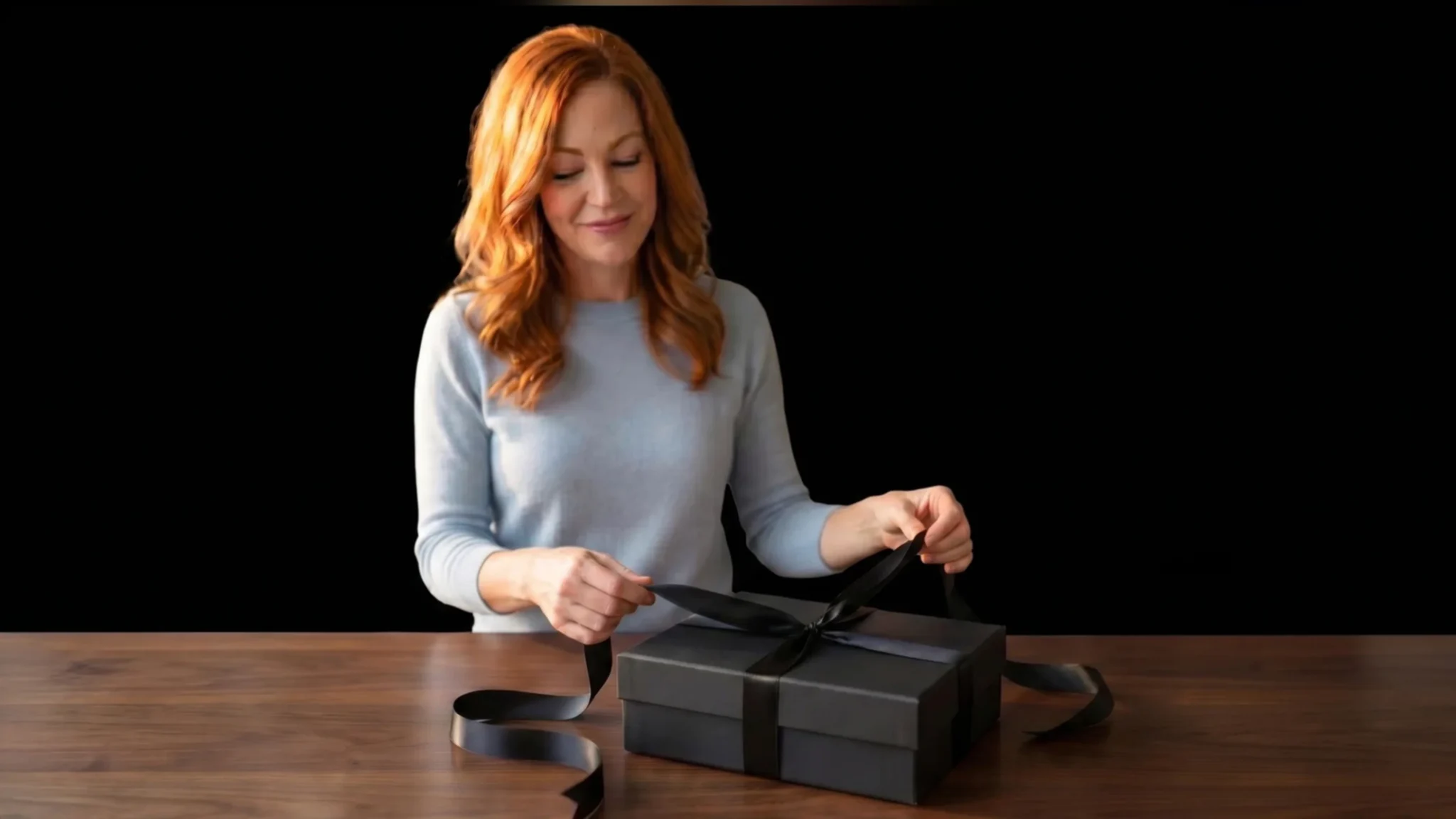
This interview is with Krista Kennedy, Director of Corporate Sales- ekuBOX, ekuBOX.
Krista, to kick us off, how do you describe your role as Director of Corporate Sales at ekuBOX and the expertise you bring to luxury corporate gifting and curated boxes?
My role sits at the intersection of strategy and story. Paula Slof, our founder, creates the most beautiful gift boxes I have ever seen. My job is making sure the right companies know they exist.
I came to ekuBOX with a decade of enterprise customer success experience — scaling client programs at Duck Creek Technologies and Buckle Insurance through Series A and B transitions.
I understand what it means to build relationships that drive measurable retention outcomes, and I kept seeing corporate gifting done badly. Generic swag, forgettable packaging, and automated platforms that optimize for volume instead of impact.
ekuBOX is the opposite of that. Every box is hand-adorned by Paula personally in our Michigan studio. Every note is handwritten. Every item is curated around our Eat. Keep. Use. philosophy:
- Something to enjoy immediately
- Something to keep
- Something for daily ritual
My expertise is translating that into business outcomes — retention, referrals, and recognition programs that actually move people. That’s what I bring to every corporate gifting conversation.
How did you get into corporate sales within retail and gift curation, and which experiences most shaped your approach today?
My path to luxury gift curation is not a straight line — and I think that’s exactly what makes my approach different.
I spent a decade in enterprise customer success and insurance — managing complex SaaS implementations, scaling operations through Series A and B transitions, and negotiating high-stakes settlements as a senior bodily injury adjuster.
None of that sounds like gift boxes. But all of it taught me the same thing: relationships are the only thing that actually matters in business. Every metric, every retention number, every renewal rate traces back to whether a person feels genuinely valued by the company they’re doing business with.
When I found ekuBOX, I recognized immediately that Paula had built something that solves a real business problem — not just a beautiful product.
A hand-adorned luxury gift box with a handwritten note from us communicates genuine care in a way that no automated platform can replicate.
My enterprise background means I speak the language of HR directors, executive assistants, and account managers. I understand their goals, their budgets, and their timelines. I just happen to be selling something that’s also genuinely extraordinary.
Building on that, when a large brand approaches you, how do you run discovery and situation analysis to align a gifting program with their brand voice, audience, and measurable goals?
Every corporate gifting conversation starts with one question: what do you want the recipient to feel?
Not what do you want to send. What do you want them to feel? That distinction changes everything about how we approach the program.
Our discovery process is a 30-minute conversation — what I call a strategy session — where we dig into four things.
- The gifting goal: are we driving client retention, employee recognition, or event impact?
- The recipient profile: who are these people and what do they value?
- The timeline and scale: one box or five hundred?
- The budget: not to find the cheapest option, but to understand what level of intentionality is possible.
From there I recommend one of three tiers:
- Ready-to-Ship for immediate needs.
- Semi-Custom for branded programs.
- Concierge for fully bespoke experiences.
Paula Slof personally curates every Concierge program from 50-plus artisan vendors.
The measurable goals come last but matter most. We track renewal velocity, referral rates, and employee sentiment because a gifting program that can’t demonstrate ROI is just an expense.
ekuBOX is designed to be a strategy.
On the curation side, what criteria do you use to select products and partners so a luxury box feels bespoke yet remains on budget and on time?
The curation standard at ekuBOX starts with Paula Slof and a single question she asks about every item she considers: does this belong? Not: does it photograph well. Not: is it on trend. Does it belong in this box, for this recipient, alongside these other items — and does it meet the Eat. Keep. Use. standard.
Every ekuBOX is built around three dimensions.
- Something to enjoy immediately — an artisanal treat or specialty food that creates a visceral positive memory the moment the box is opened.
- Something to keep and display — a Baobab Collection candle in hand-blown glass, a MATCH Pewter piece handcrafted in Italy, a Shinola timepiece assembled in Detroit.
- Something for daily ritual — a product that earns a permanent place in the recipient’s routine and keeps your brand present quietly, every day.
On budget and timeline — that’s where my operations background becomes relevant. I have managed enterprise portfolios exceeding sixteen million dollars in annual value. I understand scope, lead time, and what happens when you don’t plan.
From a sales strategy perspective, how do you structure and move an enterprise prospect through the corporate gifting cycle—from first conversation to pilot to rollout?
The sales cycle for corporate gifting is fundamentally different from traditional enterprise sales — and most gifting companies approach it wrong.
They lead with the product. I lead with the problem. The first conversation is never about ekuBOX. It’s about what the prospect is trying to accomplish — are they losing clients they should be keeping? Are they recognizing employees in ways that aren’t landing? Are they sending holiday gifts that get forgotten by January?
I ask those questions and I listen carefully, because the answers tell me everything about which tier makes sense and what success looks like for them.
From there the structure is clean:
- Discovery conversation to understand goals, budget, timeline, and recipient profile.
- Strategy fee — $149 for Semi-Custom, $595 for Concierge — that signals mutual commitment and funds the proposal work.
- Custom proposal delivered within 48 hours.
- Approval, payment, and production.
The pilot is usually a single cohort — twelve to thirty boxes — so the client can see the quality, measure the response, and build the internal case for a larger rollout. In my experience the pilot sells the program.
When a CHG Healthcare volunteer or a Disney executive opens an ekuBOX, the feedback does the work for us.
Rollout follows naturally from results.
When it comes to target markets, how do you segment corporate gifting use cases in order to focus your outreach and proposals?
Corporate gifting looks different depending on who is buying and why — and the mistake most gifting companies make is treating it as one market.
We segment by trigger, not by industry. The most powerful gifting moments are not calendar-driven. They are relationship-driven.
- A new employee’s first day.
- A client who just renewed a significant contract.
- A volunteer who gave up their weekend.
- An executive assistant who holds everything together and is rarely acknowledged for it.
- A real estate agent whose closing gift is the last impression they leave before the referral conversation happens.
Each of those triggers has a different buyer, a different budget, and a different definition of success. So our outreach is structured accordingly.
For HR Directors and People Operations leaders, we lead with employee retention data — Gallup’s research on recognition, the measurable impact of intentional onboarding gifts on 90-day retention.
For executive assistants managing C-suite relationships, we lead with speed and quality — no minimum, ships in 48 hours, trusted by Disney and Netflix.
For real estate professionals, we lead with referrals — the closing gift that gets photographed, shared, and talked about is the one that generates the next transaction.
Same product. Completely different conversation. That specificity is what converts.
What metrics do you ask enterprise clients to track to quantify ROI and value realization from gifting programs?
The biggest mistake in corporate gifting measurement is looking for immediate sales attribution. A gift is not a coupon. The ROI window is longer and the signals are different.
Here’s what I ask clients to track.
- Renewal velocity — Are gifted accounts renewing faster and with less friction than non-gifted accounts? Harvard Business Review and Bain established that a 5% improvement in retention can increase profits by 25% to 95%. A gifting program targeting your top 20 accounts does not need to move all of them to generate meaningful returns.
- Referral rate — Are gifted clients sending new business at a higher rate than the baseline? For real estate professionals, this is the most direct ROI signal available.
- Qualitative feedback — What are recipients actually saying? When CHG Healthcare switched from gift cards to ekuBOX, volunteers stopped saying “thank you” and started saying they felt seen. That distinction is not soft data; it is a leading indicator of loyalty.
- Meeting acceptance rates — HockeyStack’s analysis of 30 B2B companies found that outbound emails accompanied by a strategic gift achieved a 3.08 times higher meeting booking rate. For sales teams using ekuBOX as a pipeline tool, that metric is trackable from day one.
- Attribution window — Measure at 90 days minimum.
Gifting compounds.
When a high-stakes gift misses the mark or a shipment fails, how do you handle crisis communications and service recovery to strengthen the relationship?
This question matters more than most people in gifting want to admit. A missed delivery or a damaged box at the wrong moment — a client anniversary, a volunteer recognition event, a C-suite holiday program — is not just a logistics failure.
It is a relationship moment. And how you handle it determines whether the client trusts you more or less than they did before it happened.
My approach comes from a decade of high-stakes stakeholder management — including five years negotiating complex legal settlements as a senior bodily injury adjuster. I learned early that the quality of your recovery matters more than the absence of problems.
The framework is simple:
- Acknowledge immediately — do not wait for the client to escalate.
- Own it completely — no deflecting to carriers or suppliers.
- Resolve it faster than they expect — a replacement ships same day if humanly possible.
- Follow up after the resolution to make sure the relationship is genuinely intact.
Paula and I are a small team. That means when something goes wrong there is no customer service queue, no ticket system, no automated response. The founder or the Director of Corporate Sales picks up the phone. In my experience, that call — the founder calling personally — does more for client loyalty than a flawless delivery ever could.
During Q4 peaks, how do you maintain hand-adorned quality and personalization at scale while managing inventory, forecasting, and last-minute requests?
This is the question every corporate client asks before they place their first large order. I appreciate that they ask it — because the honest answer is what makes ekuBOX different.
We do not scale the way a warehouse scales. We scale the way a studio scales — carefully, deliberately, and with Paula’s hands on every box.
That means Q4 planning starts in August. Inventory forecasting is based on prior-year order patterns. Early conversations with corporate clients about holiday programs mean we are building production timelines in September, not scrambling in December. Heritage brand partners like Baobab Collection, Shinola, and Le Creuset have long lead times — you cannot source a Shinola Runwell Desk Clock in 48 hours. We plan for that.
For last-minute requests — and they always come — our Ready-to-Ship tier exists precisely for that moment. It has no minimum, a 24-48 hour turnaround, and the same quality standard as every other box that leaves our studio.
We keep core inventory stocked specifically to absorb the December 18th call. What we will not do is compromise the handwritten note, the dried rose petals, the wax seal, or Paula’s personal attention to every box — regardless of volume or timeline.
Some things do not scale.
That is the point.