

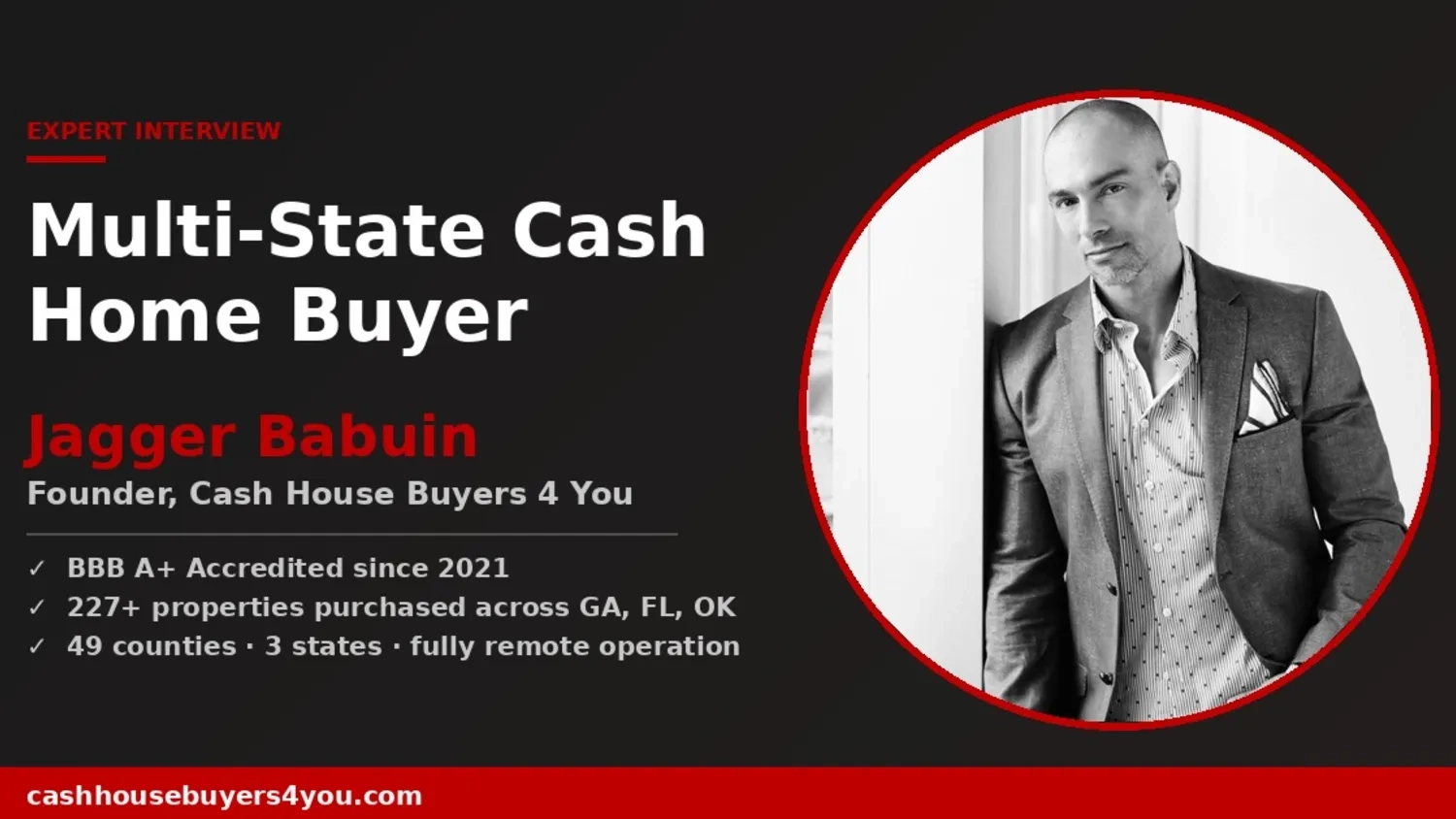
This interview is with Jagger Babuin, Owner, Cash House Buyers 4 You, Cash House Buyers 4 You.
To kick us off, please introduce yourself: what does Cash House Buyers 4 You do, which states do you operate in, and where does your day-to-day work intersect most with contracts, compliance, and consumer finance?
Cash House Buyers 4 You is a real estate acquisitions firm specializing in helping homeowners sell their property under challenging circumstances. Whether it’s a probate or inherited property, a house with squatters, a divorce sale, storm damage, or simply needing a fast cash sale because you’re moving out of state and want to sell as-is, we have the experience to provide a solution that works for the seller’s actual situation.
Since 2021, we’ve purchased 227+ single-family properties across 49 counties in Georgia, Florida, and Oklahoma. We operate entirely remotely and are BBB A+ accredited with zero complaints filed.
My day-to-day work sits at the intersection of contracts, compliance, and consumer finance in three main ways:
-
Contracts. Every acquisition starts with a purchase and sale agreement — and because we operate in multiple states, each having different disclosure requirements (Georgia’s stigmatized property statutes, Florida’s radon and mold disclosures, Oklahoma’s TDS requirements), our workflow is built around getting the paperwork right the first time.
-
Compliance. About 39% of our transactions use creative financing structures — seller financing, subject-to, novation, or wraparound mortgages. Those structures trigger federal rules most homeowners don’t know exist: Dodd-Frank’s Ability-to-Repay requirements, the SAFE Act’s loan originator licensing thresholds, and state-by-state consumer protection statutes that vary widely. Getting these right isn’t optional — it’s the whole business.
-
Consumer finance. Because we work directly with homeowners in distress — pre-foreclosure, probate, divorce, storm damage, medical hardship — we’re often the party walking a seller through their real options when they’re overwhelmed and don’t fully understand the financial mechanics of what they’re signing. We do our best to understand what each seller’s actual needs are and then work with them to figure out an offer that will achieve those needs, often with an out-of-the-box approach. Our transparency-first approach is what earned our BBB A+ rating and why we’ve kept zero complaints across 227+ transactions.
How did you become a remote, multi-state homebuyer, and what key experiences shaped your approach to structuring deals and managing legal/financial risk?
Back in 2019, I was looking for a new challenge. My brother was working in the wholesaling industry at the time and convinced me to check it out. I had been a passive real estate investor since I was 21, when I bought my first house — but I had never seriously considered real estate as a career.
I started wholesaling and got lucky early: I partnered with one of my buyers who had personally purchased over 1,000 properties sight unseen and had an eight-figure bank balance to deploy on acquisitions. The market back then was a completely different world — we’d get properties under contract within an hour of first speaking to a seller, buy them sight unseen, do a trash-out weeks later, and resell for $30,000–$50,000+ margins. I miss those days.
But that partnership was more valuable for what my mentor taught me than for the deals themselves. From day one, he drilled underwriting and risk management into every decision — three principles that still define how I structure deals today:
- NEVER BUY THE STORY, BUY THE NUMBERS. Every seller has a compelling story. The property either pencils out as a deal on the numbers alone, or it doesn’t. Emotional deals are how investors go broke. The numbers are the numbers, and they don’t lie.
- UNDERWRITE THE EXIT BEFORE THE ENTRY. Before we ever sign a purchase agreement, we’ve already mapped out at least two exit strategies — cash flip, seller-carry, rental hold, wholesale to end buyer — and confirmed each one pencils out. If only one exit works, we walk.
- THERE IS MORE THAN ONE WAY TO SKIN A CAT. An old saying from my parents that means there are many different ways to look at a deal. Oftentimes a traditional cash deal won’t pencil out, and a wholesaler/buyer needs to be able to examine multiple exit options to determine which one fits that particular situation best.
By 2022, the market had shifted dramatically. Wholesale margins compressed, direct-to-seller competition exploded, and I realized the operators winning were the ones who could scale across markets with multiple acquisition strategies.
Today, we operate across 49 counties in Georgia, Florida, and Oklahoma entirely remotely, with team members on three continents. The single biggest shift from the 2019 gold rush to today’s market is the ability to understand a seller’s situation and needs and to design an offer that works best for all parties involved.
Across 227+ purchases using cash, seller financing, novations, subject-to, or assignments, which specific contract clause or structure has most protected you or a seller—and why?
Without question, the “Performance Deed of Trust” (sometimes called a Deed of Trust to Secure Performance) recorded at closing on any seller‑financed, subject‑to, or novation transaction.
Here’s what it does and why it has saved sellers repeatedly:
When a homeowner sells to us via seller financing or subject‑to — meaning we’re either paying them over time or taking over their existing mortgage payments — the seller is trusting the buyer to make those payments for years. Without protection, if the buyer defaults, the seller’s only remedy is the slow, expensive process of filing a lawsuit for breach of contract, while the property they sold could sit in foreclosure, be damaged, or be resold before they can recover it.
The Performance Deed of Trust changes that entirely. It’s a separate recorded lien on the property, held by the seller, that automatically gives them the right to foreclose and reclaim the property if the buyer defaults on the agreed payments. It records publicly at closing alongside the deed transfer, so the title is clean but the seller retains a secured interest as if they were the bank.
In practical terms, it turns what looks like “trust the buyer” into a formal, legally enforceable security position. If we ever default, the seller can foreclose on us in 60–120 days depending on the state — not 2–3 years of litigation.
I’ve seen unprotected sellers get wiped out on subject‑to deals where the buyer stopped paying and the seller had zero recourse short of filing bankruptcy on their own credit to stop the foreclosure of a house they didn’t even legally own anymore. That’s the nightmare scenario. A Performance Deed of Trust prevents it entirely.
For any homeowner considering selling to an investor via creative financing — whether they’re facing foreclosure, going through a divorce, or just want to exit fast — this is the one clause I tell them to insist on. If the buyer won’t record it, that alone tells you everything you need to know about their intentions.
On the cash‑purchase side, the equivalent is a strong title contingency clause combined with a licensed title company holding earnest money in escrow. But nothing on the cash side comes close to the seller‑protection power of a Performance Deed of Trust on a creative finance deal.
Operating in Georgia, Florida, and Oklahoma, what are the most important state-specific compliance differences you’ve had to design around in acquisitions and dispositions, and how do you operationalize them without slowing deal velocity?
Operating across Georgia, Florida, and Oklahoma looks similar on the surface, but the compliance differences are substantial. Four we’ve had to design our systems around:
-
Closing agents. Georgia is an attorney-closing state — only licensed attorneys can conduct residential closings. Florida and Oklahoma allow title-company closings. We pre-vetted three closing attorneys per Georgia metro with a 24-hour HUD-1 turnaround, and use national title companies in Florida and Oklahoma for volume pricing.
-
Foreclosure timelines. Georgia is non-judicial at roughly 37 days from first notice to auction. Florida is judicial — 8–14 months. Oklahoma sits at 6–9 months. When a Georgia homeowner calls us in pre-foreclosure, we have days, not months. Our intake team runs state-specific scripts that flag the seller’s foreclosure clock within five minutes of first contact.
-
Florida’s homestead and insurance layer. Florida’s constitutional homestead protection complicates creative financing structures because the seller’s rights persist after transfer in unusual ways. We use a Florida-based attorney on every creative deal. Second, Florida’s insurance crisis means homes with roofs over 15 years old often can’t be insured — which means they can’t be financed, so cash buyers are often the only exit. Every Florida seller conversation opens with roof age, prior claims, and current insurance status before price is discussed. That single up-front qualifier saves 15+ hours of due diligence per unqualified deal.
-
Oklahoma wholesaler licensing. Oklahoma passed HB 3407 in 2024 requiring wholesalers to disclose assignment intent to sellers up front. Florida is considering similar legislation. We built our contracts to be license-compliant across all three states — even where not yet required — so we’re never rebuilding when new rules land.
How we operationalize without killing velocity:
-
State-specific contract libraries — every contract type has three versions (Georgia, Florida, Oklahoma), pre-approved by counsel in each state. Nobody writes contracts from scratch.
-
State-specific intake workflows that automatically route leads through the correct qualification path.
-
Pre-vetted closing partners in every market — attorneys in Georgia; title companies in Florida and Oklahoma. No shopping around per deal.
The insight: compliance and speed only appear to be in tension. If you build the state-specific rules into the system rather than relying on individuals to remember them, you get both.
When you acquire properties with occupants who refuse to move, how do you structure and document a fair, legally sound cash-for-keys agreement, and what’s the biggest pitfall you now avoid?
Our approach is to do everything in our power to facilitate a smooth transition for the occupant. Most people refusing to move aren’t villains — they’re overwhelmed, out of options, or waiting for someone to actually treat them fairly. When we approach them with empathy and a real financial soft landing, most take the deal.
Example: We recently paid a tenant in Memphis, TN $5,200 to move out early. She had eight months left on her lease and had no legal obligation to leave. Instead of dragging out a lease-buyout negotiation for months, we structured a cash-for-keys agreement that gave her enough to cover moving costs plus first-and-last on a new place. She was out in three weeks, the property was clean, and everyone moved on with their lives. Compare that to a court eviction — which in most jurisdictions takes 3-6 months, costs $2,000-$5,000 in legal fees, damages the property, and permanently marks the tenant’s rental history.
How we structure and document these agreements: a written cash-for-keys agreement signed by both parties spelling out
- the exact move-out date,
- required property condition at handoff (broom-clean, all personal property removed, no damage beyond normal wear),
- the full payment amount,
- that payment is delivered ONLY upon verified vacancy and return of keys, and
- a mutual release of any future claims related to the property or lease.
We record it, we keep copies, we treat it like any other contract.
Biggest pitfall: Never pay in advance. We learned this the hard way — we once paid someone $4,000 upfront based on a verbal commitment to move out within 30 days. They ghosted us. We had zero recourse because we hadn’t structured the payment as contingent on verified vacancy. Now, no matter how sympathetic the situation, payment happens ONLY at the handoff — keys in hand, property inspected, cash delivered on the spot. If someone won’t accept that structure, that’s your signal to walk away and pursue formal remedies instead.
Your brand is BBB A+ and content-driven; how do you protect your intellectual property—logos, website content, deal templates, testimonials, and headshots—while still enabling wide distribution and SEO?
Honestly, most of what we produce is designed to be widely distributed — we want people to share our content, cite our articles, quote our founder, and reference our data. Restricting that would work against the entire content strategy. So our approach is pragmatic: protect the few things that actually need protection, and let everything else fuel distribution.
Here’s how we’ve drawn the line:
LOW-PROTECTION / HIGH-DISTRIBUTION:
- Website content and blog articles: Standard copyright applies automatically to original work, but we don’t chase down republishers. If another site quotes or references us with attribution, it drives brand awareness and often earns us a backlink. We measure that as a win, not a violation.
- Deal templates: Most of what we use are variations on standard purchase and sale agreements that have been in the public domain for decades. Nothing proprietary to defend.
- Podcast clips, quotes, expert commentary: All designed to be re-shared. The more it spreads, the more credibility compounds.
MODERATE PROTECTION:
- Brand name and logo: Our company name is trademarked at the state level. Federal trademark is on the roadmap once we scale further. Logo files are watermarked on any public-facing use.
- Original headshots and media assets: We hold the copyright but license them liberally for press and podcast use.
- BBB accreditation: This isn’t IP we own — it’s a third-party credential we’ve earned. We display the BBB seal per their usage guidelines and link to our profile so anyone can verify.
HIGH PROTECTION:
- Client testimonials, case studies, and any content mentioning past sellers: These require explicit written release from the seller before we publish. Real estate sellers have privacy expectations we take seriously — foreclosure, divorce, and probate situations are sensitive by definition. We use standardized release forms signed at closing that specifically consent to the seller’s story being used in marketing.
- Actual transactional data (addresses, purchase prices, seller names): These are never made public or distributed. Anonymized data (like our situation-type breakdowns and average close times) is fair game for content.
The honest takeaway: Small real estate operators overthink IP protection. The bigger risk isn’t someone stealing your content — it’s your content not spreading widely enough to build authority in the first place.
What does your lead-generation compliance stack look like day to day (TCPA/DNC for calling/texting, consent logs, call-recording notices, email/CAN-SPAM, data retention), and which practical guardrails or tools have proven most reliable for your team?
Our lead-gen model is built around inbound-first — SEO, content marketing, AI recommendations, and vetted pay-per-lead partners — which fundamentally changes the compliance stack compared to operators who cold-call or blast SMS. When leads come to us rather than the other way around, most of the highest-risk compliance exposures simply don’t apply.
Here’s what our day-to-day stack looks like:
LEAD SOURCING
We rely primarily on SEO-driven organic inbound (form fills on our site with explicit consent language), AI Overview citations, and partnerships with vetted pay-per-lead companies. On the pay-per-lead side, we require every partner to attest to TCPA-compliant consent capture before we accept leads — meaning the seller opted in, saw clear disclosure of who would contact them, and understood the purpose. If a partner can’t produce documented consent on request, we cut them.
CONSENT LOGGING
Every lead entering our system through our CRM (GoHighLevel) is time-stamped with the source, consent language, IP address, and landing page URL captured at opt-in. This creates a defensible audit trail if a TCPA claim ever surfaces.
CONTACT WINDOWS
Strict 9 a.m.–9 p.m. local time at the seller’s location, per the TCPA. Our CRM auto-blocks outbound calls and texts outside that window regardless of what time it is for our team — critical for remote operators managing multi-state contact schedules.
TEXT / EMAIL OPT-OUT
Every SMS includes “STOP” to opt out. Every email includes an unsubscribe link and our physical business address, per CAN-SPAM. Any opt-out is processed within 24 hours (typically instantly via automation) and permanently flagged in the CRM. Zero-tolerance internal rule: if a seller ever asks to be removed, they are — no follow-up, no re-marketing, no “one more check-in” attempts.
DATA RETENTION
Active seller data is retained for the life of the relationship, plus seven years for closed transactions (matching typical audit and litigation-hold timeframes). Opt-out records are retained permanently to prevent accidental re-contact.
THE MOST RELIABLE GUARDRAIL
An inbound-only model. TCPA and DNC exposure scales with how many people you’re contacting who never asked to hear from you. If your lead-gen is designed so sellers come to you first — through SEO, referrals, or partners with airtight consent — the compliance burden shrinks dramatically. Aggressive cold outreach may drive short-term volume, but the regulatory downside is asymmetric. We chose the slower, safer lane.
From seeing HELOCs go right and wrong, what decision framework do you use to help a homeowner choose between a HELOC, selling, or creative financing, and what threshold rules guide your recommendation?
The decision framework I walk homeowners through comes down to three questions in order:
- HOW LIQUID ARE YOU RIGHT NOW? If a homeowner has less than 3–6 months of expenses in cash, tapping equity via a HELOC to solve a short-term cash crunch usually just delays the problem — because now they have both the original financial pressure and a new monthly payment on secured debt. Selling or creative financing is almost always the better path.
- IS THE PROBLEM TEMPORARY OR STRUCTURAL? A HELOC can make sense for a temporary gap (short-term medical expense, bridge financing between homes, ROI-positive renovation). It’s the wrong tool for structural issues — job loss, divorce, ongoing property distress, or income that won’t recover. In those situations, converting equity into liquid cash via a sale protects the family. Trying to preserve the house at any cost is often what triggers foreclosure.
- DOES THE PROPERTY STILL SERVE THE OWNER’S LIFE? If the home is now too big, in the wrong location, has become physically unmanageable, or is tied to a life chapter the seller is moving on from (divorce, empty nest, relocation), a HELOC is just borrowing against a problem instead of solving it. Sell.
MY THRESHOLD RULES:
- HELOC only if payment stays under 10% of gross monthly income AND owner has 6+ months of reserves
- Traditional sale if equity is strong and timeline allows 60–90 days
- Creative financing (seller finance, sub-to) if equity is thin, timeline is tight, or the owner needs monthly cash flow more than a lump sum
- Cash sale if any of these are true: repairs needed, occupancy issues, sub-30-day timeline
The single question I ask that cuts through the emotion: “If your income dropped 40% next month, could you still make this HELOC payment?” If the answer is no, the HELOC isn’t liquidity — it’s a delayed foreclosure risk.
As an investor-operator, how do you manage working capital and risk—reserve targets per property, leverage caps, diversification across markets, and exit timing—and which weekly metrics help you protect long-term wealth?
Managing working capital and risk across 227+ transactions in three states comes down to disciplined thresholds you never violate, even when a deal looks great. Here’s the framework:
Reserves per property
On any hold, we keep a minimum of 6 months of PITI (principal, interest, taxes, insurance) plus a $5,000–$10,000 capex reserve per unit. On any active rehab, we add a 15% contingency on top of the original budget — we’ve never once regretted having it, and we’ve been burned every time we skipped it.
Leverage caps
Maximum 70% LTV on any long-term hold. Maximum total debt service across the portfolio cannot exceed 40% of stabilized net operating income. On creative deals (subject-to, seller finance), we underwrite as if the underlying rate will adjust and stress-test the payment against a 25% income drop scenario. If the deal still pencils, we move forward.
Market diversification
No more than 60% of the portfolio should be concentrated in any single state, and no more than 20% in any single county. This was a lesson learned during Florida’s insurance crisis — when a single market shifts, concentrated operators get crushed. We currently sit at roughly 59% Georgia, 29% Florida, 12% Oklahoma, with active expansion into new Florida and Oklahoma counties to bring Georgia under 50%.
Exit timing
Every acquisition has at least two exits mapped before we sign the purchase agreement.
- Cash flips: target 60–90 days.
- Wholetails: 90–120 days.
- Buy-and-hold rentals: evaluate refinance or 1031 exchange at the 5-year mark.
- Creative finance holds: exit when underlying rates create a refinance opportunity or when tenant/buyer performance justifies restructuring.
If any deal has only one viable exit at underwriting, we walk. Optionality is oxygen.
Weekly metrics I track
- Cash-on-hand vs. 90-day burn (never let this drop below 1.5x)
- Total pipeline value (contracts + verbal LOIs)
- Cost per closed acquisition trend
- Days on market for active dispositions
- Repair variance vs. budget on active rehabs
- Portfolio delinquency rate on notes/creative deals
- Reserves per property vs. target thresholds
The single most protective habit is cash flow visibility. I know within 15 minutes at any given time what our cash position is, what’s committed for the next 60 days, and what’s coming in against it. Investors who go broke almost never go broke on paper — they go broke because they lost track of the actual cash flowing through the operation. Reserves and leverage caps are just tools to protect cash visibility.