

This interview is with Conor Keenan, Co-Founder, CompareAccounts.
Conor, as Co-Founder of CompareAccounts and an Accredited Wealth Management Advisor, how do you introduce your expertise and the mission of CompareAccounts to readers of https://connectively.us?
CompareAccounts exists to help make financial comparisons easier for everyday Americans. People are overwhelmed with options: checking accounts, savings accounts, brokerage accounts, credit cards, loans, etc. The “best” choice really depends on that person’s individual goals, habits, and financial situation.
As the co-founder who earned the Accredited Wealth Management Advisor designation, I help people cut through the noise and understand their options to make more confident money decisions.
What experiences and market gaps led you to co-found CompareAccounts in financial services?
Earlier in my career, I had the chance to work on a similar business. The challenge with that business was that it was overly promotional and only showed offers that paid them the most per click, which is not in the best interest of the user and is rarely in the best interest of the partner.
In general, this meant their comparison content was either too shallow, too promotional, or too disconnected from how people actually make decisions.
The rate of a savings account matters, but so do the fees, restrictions, and trade-offs that may exist. That’s how we help people move from considering an account to deciding ‘this account is right for me.’
Building from your work at CompareAccounts, what first-principles framework do you use when comparing checking, savings, CD, and brokerage accounts for consumers?
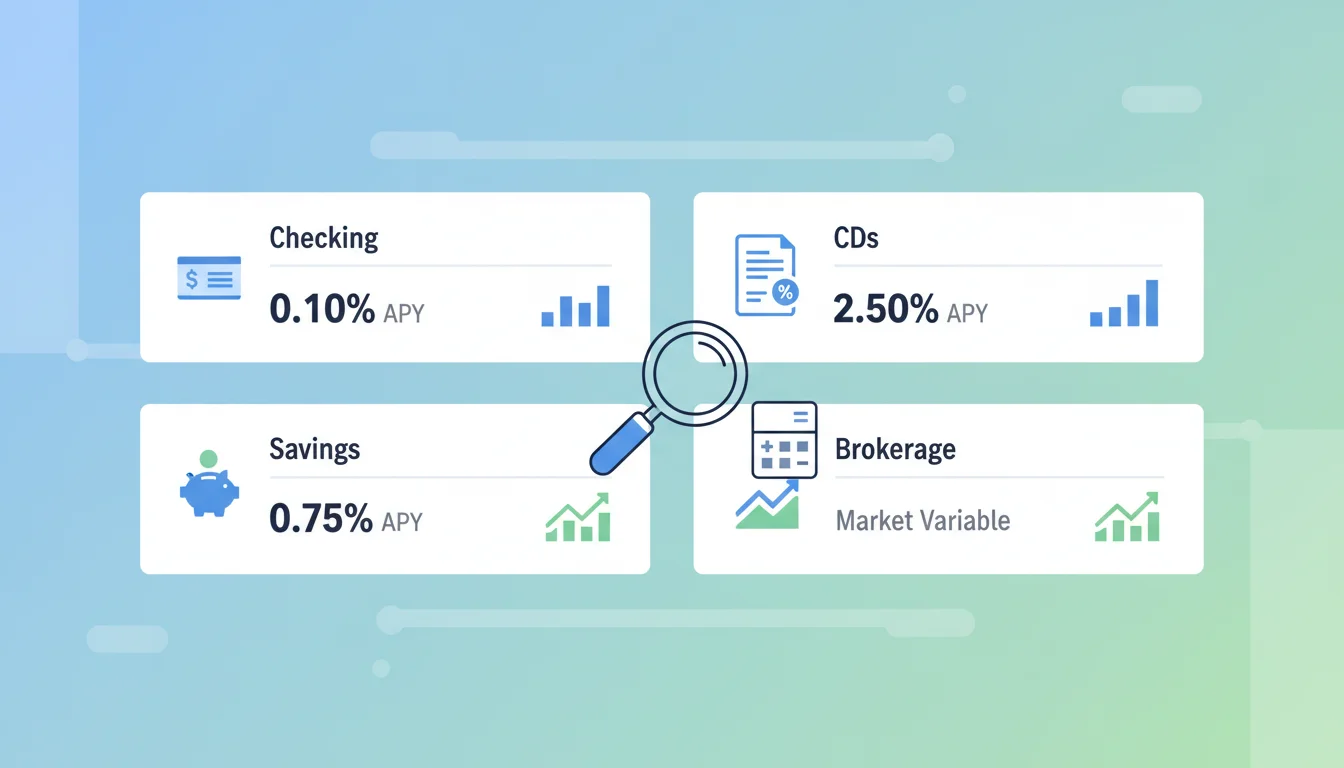
We start by identifying the job or function each account should accomplish for the person.
A checking account should make daily money management easy and inexpensive.
A savings account should protect cash while earning a competitive yield.
A CD should provide peace of mind for those looking for lower risk but higher yields than a savings account.
A brokerage account should make long-term investing accessible, low-cost, and aligned with the investor’s needs, wants, and goals.
From there, we rate the offer(s) across the following dimensions.
- Offer
- Monthly Fees
- Brand
- Minimum Opening Deposit
- Customer Support
- Security Features
Zooming into checking, what does your 10-minute audit checklist look like for students, freelancers, and high-net-worth users?
For students, look for:
- monthly fee information
- minimum balance requirements
- ATM access (especially near campus)
- overdraft rules
- peer-to-peer payments like Zelle
- mobile deposit
- whether being a student is a requirement
A free account is great until it turns into a fee machine for the bank after graduation.
For freelancers, look for features that support cash-flow control:
- how easily they can create separate buckets or “envelopes” to stash funds for taxes, operating expenses, and personal income
- check transfer speeds
- mobile deposit limits
- any incoming wire or ACH rules
- bookkeeping integrations, which are a nice-to-have to help make tax time easier
Ultimately, freelancers need less of a place for their direct deposit to land and more of a way to create a money management system that works for their growing business.
For HNW individuals, look for:
- FDIC coverage limits
- cash sweep options
- wire limits (both incoming and outgoing)
- dedicated support
- other services, protection, and features beyond those for other user types
Therefore, the “best” checking account for a HNW household is less about avoiding a $25 monthly fee and more about how this account fits into their overall portfolio from a liquidity, security, and service perspective.
On savings analysis, how do you tailor your process for consumers with volatile cash flows or limited access to fee-free banking?
For folks with volatile cash flow, the key is to ensure they have enough of a buffer to protect against large swings. It helps to have at least two buckets set up for this.
- Emergency savings – this is for true surprises: your car needs to be fixed, you get a speeding ticket, etc.
- Timed expenses – these include things like taxes, insurance payments, rent, etc.
From this perspective, the “best” savings account likely isn’t the one with the highest APY but the one that allows the person to create these buckets while also providing quick transfers in case of an emergency.
For folks who have limited access to fee-free banking, many fee-free options are available if you have a phone. We have a whole page dedicated to this type of need. If you don’t want to change banks, the key is to mitigate the fees you do or can be charged.
- Avoid out-of-network ATMs
- Avoid overdrafts
If you find you keep getting charged fees that are avoidable, it’s probably best to change who you bank with.
Shifting to brokerage accounts, how do you map investments across taxable brokerage, Roth IRAs, and HSAs to optimize asset location?
A general framework is as follows:
-
Taxable brokerage: Place tax-efficient, flexible investments in your brokerage account. Think broad-market ETFs with low expense ratios and long-term equity holdings where the investor has control over when gains are realized.
-
Roth IRAs: A Roth IRA is where you put high-growth investments because this account allows investments to compound tax-free, which can be especially valuable depending on your tax bracket in retirement.
-
Health Savings Accounts (HSAs): An HSA is one of the best tax-advantaged investments a person can make. Contributions lower your tax liability, you can invest contributions where the gains are tax-free, and when you withdraw funds for qualifying medical purposes, those withdrawals are tax-free. With the rising cost of healthcare, it’s always a good idea to invest in an HSA if you can. HSAs require meeting certain conditions before you can contribute to one.
For a quick win this week, what single account change—checking, savings, CD, or brokerage—do you most often recommend that delivers the biggest dollar impact with minimal hassle?
One of the easiest wins is to open a separate savings account from your checking account. People often run into money problems when their direct deposit just lands in a big pile in their checking account.
Setting up a new savings account and arranging automatic transfers to that account on payday is the best way to start seeing dollars pile up.
Once that account reaches a certain threshold, the person can decide what to do with it: invest it in a brokerage account, spend it on travel, pay off debt, etc.
A slightly more complicated version is to move your direct deposit to a checking account with a bonus and no or lower fees. Bonuses are usually $300 or more, but they typically require moving your direct deposit and meeting certain other terms and conditions.
In general, I prefer the checking-and-savings setup mentioned first, as that builds the habit, whereas the second option is more of a “quick fix” and doesn’t solve the underlying savings problem most people have.
Thanks for sharing your knowledge and expertise. Is there anything else you'd like to add?
Thanks for the opportunity!