

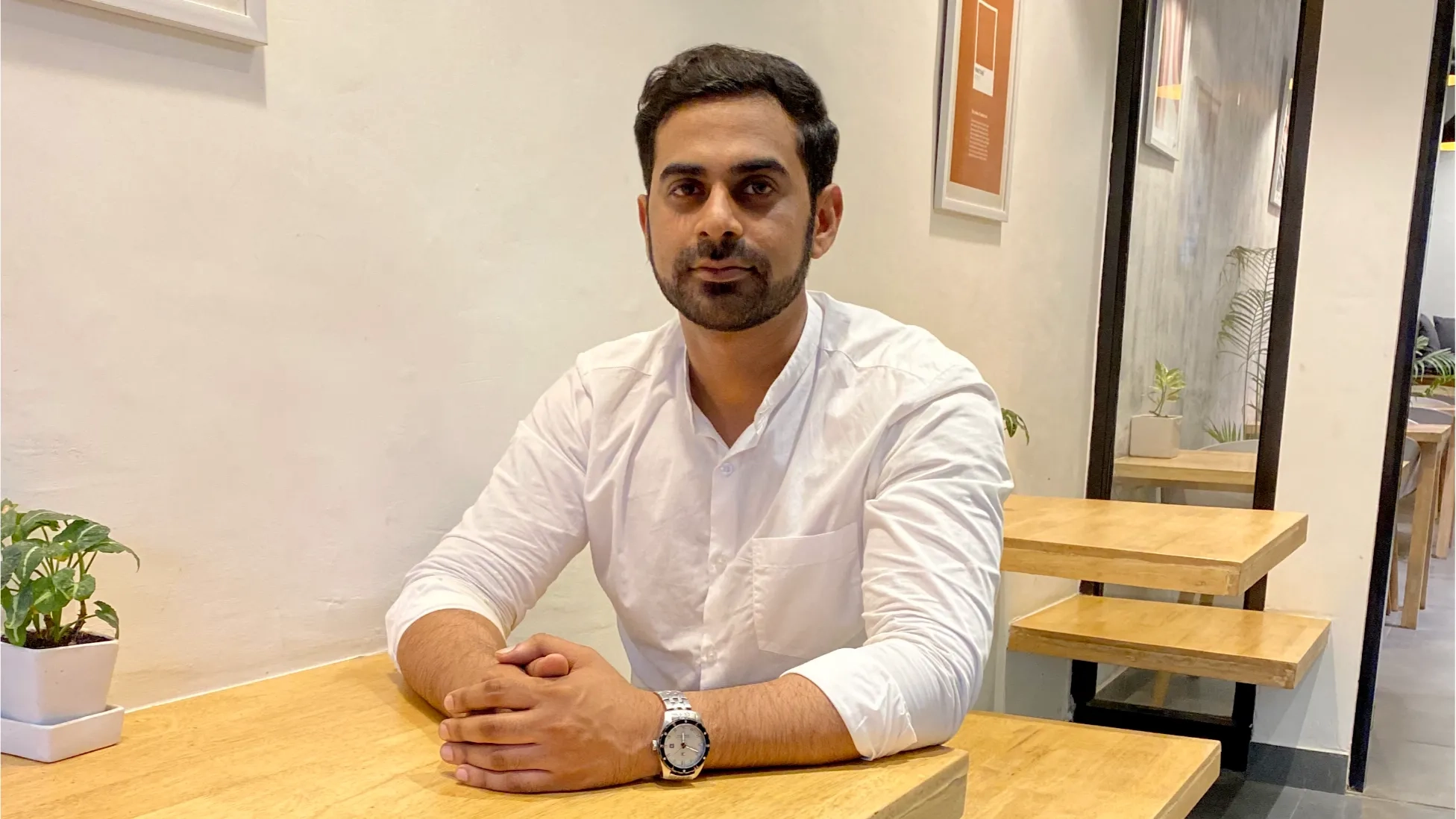
This interview is with Ashish Kumar, Founder, Red Dash Media.
Ashish, for Connectively readers, how do you introduce what you do today as a Founder in the design industry, and the kinds of growth challenges you solve for brands?
I run Red Dash Media, a full-service digital marketing agency.
Quick correction first, just so the piece frames it right: we are a marketing agency rather than a design firm.
Day-to-day, I work with brands on the growth problems that actually move the needle:
- Getting found in search now that AI is rewriting how people look for things
- Turning content into something that earns attention instead of just filling a calendar
- Making sure marketing spend ties back to real business results, not vanity numbers
Most brands don’t have a traffic problem; they have a “being chosen” problem. That’s the gap I work in.
What was the key turning point that took you from hands-on design and front-end work (Photoshop, Illustrator, HTML/CSS) to founding and leading a growth-focused studio?
The turning point was realizing I was making things look good that weren’t doing anything. I could build a clean site or a sharp design, hand it over, and watch it sit there—beautiful and ignored.
The craft wasn’t the problem; the result was. At some point I stopped caring whether something looked impressive and started caring whether it actually grew the business behind it.
Once that switch flipped, the front-end work became a means, not the point. That’s really what Red Dash Media was built around: design and build in service of growth, not for its own sake.
Drawing on your logo and web design background, when you kick off a new engagement, how do you translate brand fundamentals into a campaign system across social and web that can scale week after week?
It starts with getting the fundamentals down on paper before anyone designs a single post: who the brand is, who it’s actually talking to, and the one thing it wants to be known for.
Skip that, and you get a pretty feed that says nothing. Once that’s clear, I turn it into a simple system, not a pile of one-off ideas.
That means a few content angles the brand owns, a consistent look, and a repeatable format for each channel, so the team isn’t reinventing everything every week. That’s what makes it scale.
The brand stays recognisable whether you’re looking at the website or a Tuesday social post, and the team can produce week after week without starting from zero each time. Consistency is the thing that compounds. Cleverness that changes every week just confuses people.
What is your personal workflow for producing high-volume, on-brand social content—using Adobe Creative Suite and AI video where it helps—without losing creative quality?
The honest answer is: I don’t chase volume by working faster; I chase it by repeating a system. The quality stays because the thinking is done up front: the brand’s angles, look, and formats are decided once, so day-to-day production is assembly, not invention. That’s what prevents high volume from turning into mush.
AI is where the real leverage is now—especially video. Work that used to require a shoot and a week of editing we now build and assemble in a fraction of the time. This means a brand can show up for every moment on the calendar instead of the one or two it could afford to produce properly. I treat AI as the first ninety percent, never the last. The final ten percent—the brand details, the product being exactly right, the polish—is still human. The tool gives you speed; it doesn’t give you taste. Keep a person on the last mile, and volume and quality stop being a trade-off.
Beyond likes and views, which engagement metrics tell you a social campaign is actually deepening brand affinity and intent, and why those over vanity metrics?
Saves and shares over likes, every time. A like is a reflex — it costs nothing and means nothing. A save means someone thought “I’ll need this later,” and a share means they were willing to put their own name behind it to their followers. Those are actions with a cost attached; anything a person spends effort on tells you far more than what they tap without thinking.
After that, I watch the unglamorous ones: replies and DMs, because a conversation is worth more than a hundred passive views, and branded search — people leaving the platform to look you up by name. That last one is the real tell of intent. Nobody Googles a brand they feel nothing for.
- Likes tell you a post performed.
- Saves, shares, and someone searching your name later tell you the brand is actually landing.
- One measures the post. The other measures whether anyone will remember you tomorrow.
How do you personalize on-site and social experiences using only first-party signals so the experience feels helpful and respectful to users?
The rule I stick to is to personalize based on what someone actually did with us, never on what I could guess about them. First-party signals — the pages they viewed, what they bought, where they are in their journey — are fair game, because the person handed that to me just by using the site. It feels like good service, not surveillance. The moment you start stitching in data from elsewhere to guess who they are, it tips into creepy, and trust costs far more to win back than a click costs to earn.
The practical version: I personalize the usefulness, not the person. I don’t show someone that I know their age or city. I use what they did to surface the next thing that’s actually helpful — the product they were looking at or the step that fits where they are. They don’t feel watched; they just feel like the experience got easier. Same data, completely different feeling.
What experiment design do you rely on to decide quickly whether a creative concept deserves more budget—your approach to test size, time window, and clear success or kill criteria?
My rule is to decide the kill criteria before the test runs, not after. The trap everyone falls into is launching a concept, watching the numbers, and then talking themselves into why a weak result is actually fine. If you write down what success looks like before you spend a rupee, you take your own bias out of it. The concept either clears the bar you set when you were thinking clearly, or it doesn’t.
In practice, I keep the window short and the spend small — enough budget and enough days to get a real read, not so much that a dud quietly drains the month. I pick one metric that matters for that specific concept, set the number it has to beat up front, and hold the test to it. If it clears the bar, it earns more budget. If it doesn’t, it’s killed, even if I love it. Especially if I love it — the ideas you’re emotionally attached to are exactly the ones you’ll keep funding past the point of sense. The discipline isn’t in reading the results; it’s in committing to the rule before you see them.
You’ve argued for building content to be cited by AI, not just ranked—how has that changed your social and content mix for brand engagement?
The biggest change is that I stopped treating social and content as two separate jobs. Once the goal becomes getting cited by AI, not just ranking, everything you publish anywhere feeds the same machine. The model reads your blog, but it also reads what’s said about you in interviews, podcasts, comments, and other people’s articles. So the mix shifted from ‘publish on our channels’ to ‘be a named voice everywhere the conversation is happening.’
Concretely, that means more of our effort now goes into content with a person and an opinion attached, rather than faceless brand posts. A clear point of view from a real name is what both people and AI engines latch onto — a generic ‘5 tips’ post is invisible to both. So the social mix tilted toward founders and experts saying something they’d actually defend, and away from polished corporate filler. The brands winning at this aren’t the ones posting the most; they’re the ones with a recognisable human voice the AI can quote and an audience can trust. Faceless scales to nothing now.
When resources are tight in the first 90 days, what simple framework do you use to allocate effort across content production, paid distribution, and digital PR to drive growth?
In the first 90 days, my rule is to front-load what gives you a fast read and delay what only pays off slowly. Tight resources and a short clock mean you can’t afford a bet that takes six months to tell you whether it worked.
I split effort by speed of feedback. Paid distribution comes first because it’s the fastest teacher — a small spend tells you, in days, which messages and audiences actually respond, and that intelligence makes everything else sharper. Content production runs alongside it but is more pointed: instead of publishing broadly and hoping, I create content around whatever paid distribution just proved people care about. I treat digital PR as the long game — worth starting early because it takes time to land, but I don’t lean on it for a 90-day result. It’s planting, not harvesting.
The principle: in a short window, spend first on the things that talk back quickly, and use what they tell you to aim the things that don’t. Most teams do it backwards — they pour the early budget into the slow, exciting bets and have nothing to show when the 90 days are up.
Thanks for sharing your knowledge and expertise. Is there anything else you'd like to add?
Just one thing.
Everything I’ve said comes back to a single idea: in a world where AI can generate infinite average content, the only edge left is being genuinely useful and genuinely yourself. Stop trying to game the system and start being the source worth citing — the real number, the honest opinion, the thing nobody else is saying.
That’s harder to fake than it’s ever been, which is exactly why it’s the thing worth doing. Thanks for having me.