


How to Improve Employee Onboarding and Reduce Early Turnover
Written by Divya Vijaykumar
A new hire might have a great first day but a terrible first month. What I have observed about employee onboarding procedures is that they are designed with the first day in mind and abruptly end there, which is generally around the time the individual starts needing it most.
In Enboarder’s 2025 HR Leader Survey of 1,000 HR leaders, which was published in August 2025, 20.5% said that up to half of their new hires leave within the first 90 days. It is a vendor survey asking the HR heads to calculate the attrition based on their own estimates instead of looking at a payroll report; hence, the shape can be believed, but not the smaller decimals.
What Should the Hiring Stage Hand Over?
In the same survey, only 36% described the transition between recruiting, HR, and hiring managers as being “seamless”. I believe this, since most of the things that need to be known about the newly recruited candidate are done before recruiting and then never even spoken about after the offer letter is given.
An AI resume screener, for instance, gives you two lists for every interview – the requirements they met comfortably and the ones they only barely cleared. That second list is the most useful 30-day learning plan anyone will hand a manager; however, it usually gets handed nowhere. I started copying it into the joining email, and it changed what the first one-to-one was about.
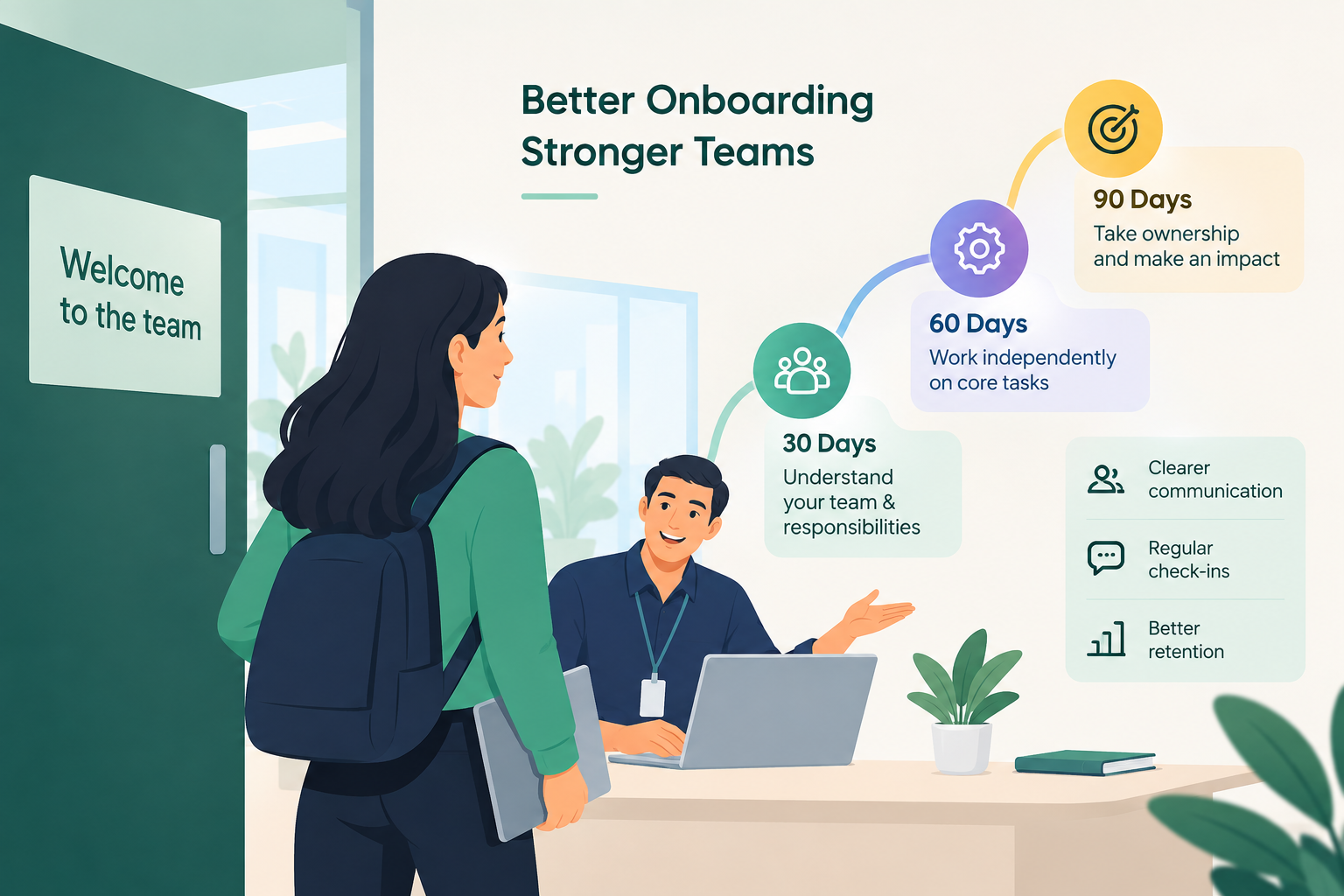
Can 30, 60 and 90 Days Mean Three Different Things?
A 30/60/90-day onboarding plan works when each phase answers a different question, not when it’s a long checklist. At 30 days, can the person describe what their team is accountable for and who signs off on what? By day 60, can they do the core task without somebody overseeing their every move? The 90-day question is whether they are in charge of something that would become apparent when stopped.
Gallup held a 2026 workplace poll of 43,262 US employees, which was fielded in February and May 2026 and carried a 0.7 margin of error, and found that 49% strongly agreed they know what is expected of them at work, which is up from 47%. It is not broken out by tenure, so it covers the whole workforce.
Manager Check-Ins Are the First Thing to Slip
Of those HR leaders, 28.8% said they had seen hiring managers give new hires no training or guidance at all. A weekly conversation is the cheapest course correction. You can ask them three basic questions: what is clear, what is confusing, and where are you stuck?
One of our new employees went quiet after a few weeks of joining, and her manager read it as she was settling in. She had been waiting eleven days for access to a tool and did not want to be the person complaining in month one. A fifteen-minute check-in would have caught this issue much earlier.
Check-ins do fail, and predictably they turn into status reports. Once a manager opens by asking what got done, the new hire starts preparing, and an admission of confusion is the last thing anybody volunteers in a meeting they have meticulously prepared for.
Admittedly, I don’t have a solution to this problem. What has worked a little better for us is asking the manager to find out what the newbie still can’t do alone.
There is also a temptation to use data to answer the ramp-up question for people who join remotely. Employee monitoring software can tell you how much time the person was working and how many tickets were involved, but it cannot tell you if the person understood what they did. The person joining who reads the documents in silence during the first month will be considered unproductive, while the one confidently shipping the wrong thing looks very useful.
Ask the Ones Who Leave
If a new hire has been in the organization for 90 days or less, then there is one question I would always ask: what did you think in the interview that you later discovered to be untrue? The same thing happened twice for us, and it concerned the amount of hands-on versus coordinating work. This is usually a recruiting issue that is masked as an onboarding problem.
The part I have not figured out is who owns those initial 90 days. HR designs the process, the manager implements it, and the individual who decides whether the weekly check-in will survive a busy quarter is the manager’s boss.
That individual has never had a number assigned to them. Until they do, onboarding will continue to get postponed.
About the author: Divya Vijaykumar is the HR manager at Hyring, where she runs hiring and onboarding for the engineering and support teams.