

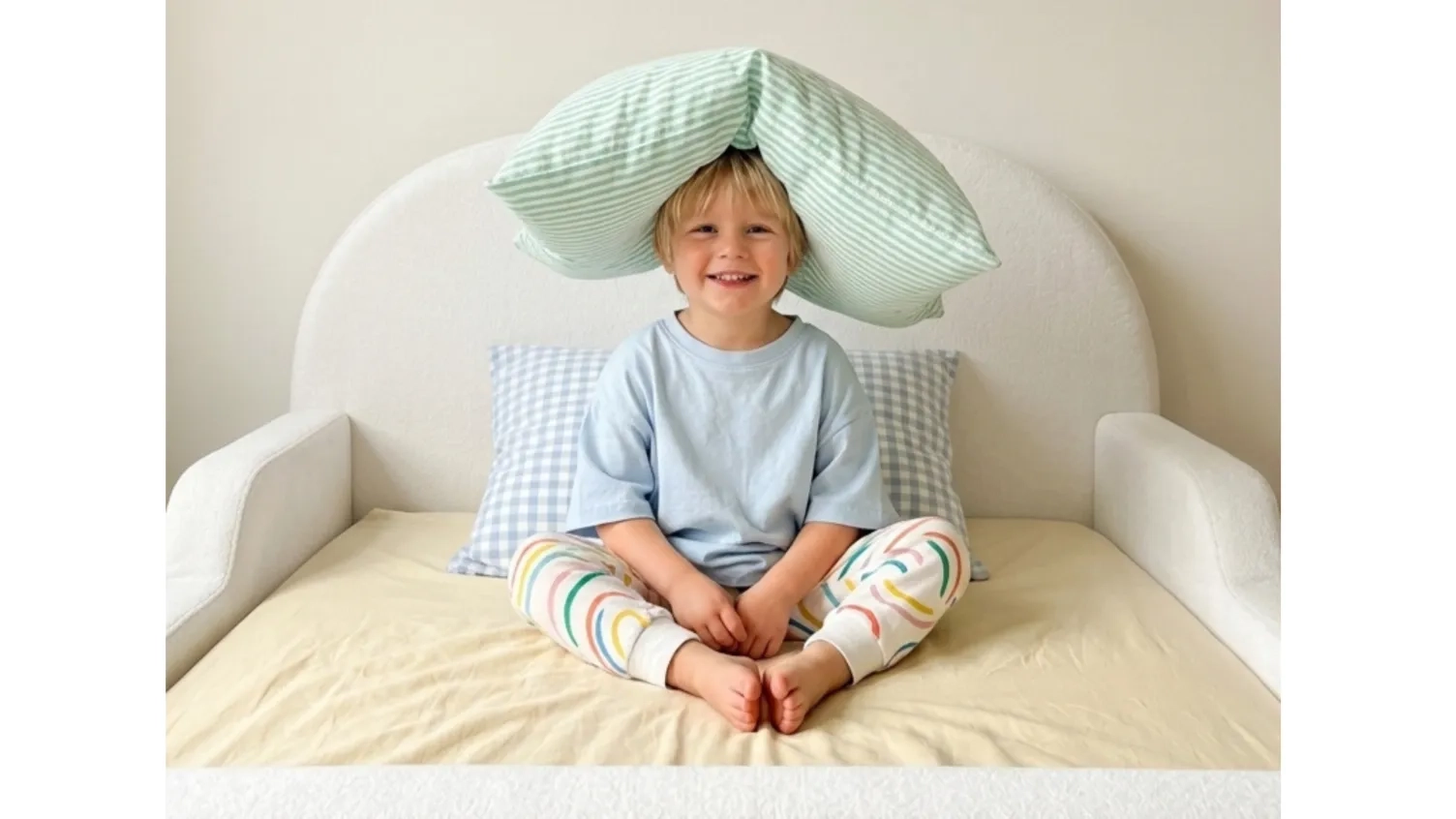
This interview is with Dr. Deepak Khanna DO, Family Medicine Physician and Founder, Montessori Bed Company.
Dr. Deepak Khanna, as a family medicine physician and founder of Montessori Bed Company, what perspective do you bring to conversations about children’s sleep and bedroom design?
I spend every week in a family medicine exam room, and parents’ questions about sleep come up constantly.
For years, I watched the same bedtime story repeat in different families: lifting a child into bed, negotiating, and listening to them call out.
My perspective is that the room itself is part of the answer. Most sleep conversations focus on schedules and routines, and those matter, but I pay equal attention to the physical environment, because a bedroom scaled to the child changes what the child can do for themselves.
That idea is much older than my company. Maria Montessori was a physician who noticed what children could do when the environment fit them. I founded Montessori Bed Company to apply that thinking to the one piece of furniture a child uses more than any other.
What experiences in your medical practice led you to build a company focused on Montessori-style floor beds?
For years I had the same conversation. Parents described bedtime as a nightly fight: the lifting, the negotiating, and the child calling out the moment the parent left the room. I kept noticing that the bed itself was part of the problem: a piece of furniture the child could not use without an adult.
That is what led me to found Montessori Bed Company, building a floor bed around that exact problem: low to the ground so a child can climb in and out alone, and reviewed with a physician’s eye for safety. I continued practicing family medicine the whole time. The exam room is still where I learn what families actually struggle with.
When parents describe bedtime as a recurring struggle, what patterns have you noticed that the child’s sleep environment can realistically help address?
The pattern I hear most is a power struggle disguised as a sleep problem. A child who has to be lifted into bed experiences bedtime as something done to them, and children push back against that the way all of us do. When the child can get in and out of bed on their own, you remove the lifting and the negotiation from the routine, and bedtime becomes something the child does rather than something that happens to them.
I want to be honest about the limits, too: the environment helps with the resistance and independence half of bedtime. It does not fix an inconsistent schedule, an overtired child, or a routine that changes every night. Those are habits, not furniture.
How do you help families distinguish between supporting a child’s growing independence at bedtime and overlooking sleep challenges that may need clinical attention?
The line I give parents is the same line I use as a physician: discomfort is not danger. Resistance, stalling, and the occasional rough night are a normal part of a child learning to sleep independently, and stepping back is usually the right call.
What deserves clinical attention is different in kind, not in degree. These signs warrant evaluation:
- Loud snoring or pauses in breathing
- Gasping during sleep
- Persistent night terrors
- Unusual daytime sleepiness
- A child who cannot settle no matter how consistent the routine
Those should prompt a visit to your pediatrician or family doctor. Building independence never means ignoring those signals. It means not treating every protest as one.
What practical factors should parents consider when deciding whether a low floor bed is developmentally appropriate for their child?
Readiness is behavioral, not a birthday.
The classic trigger is a child climbing out of the crib; at that moment the crib becomes a fall risk rather than a safe container.
Beyond that, look for confident walking and the ability to follow simple bedtime boundaries.
The floor bed’s advantage is in the name: the distance to fall is only inches. The honest trade-off is that a floor bed converts the whole room into the container, so the real question is whether you are ready to childproof the room, not just whether the child is ready for the bed.
From your experience, what are the most important room-safety changes families should make when a child can independently get in and out of bed?
Think of the room the way you once thought of the crib.
Key safety steps include:
- Anchor dressers and shelves to the wall, because a child who can get out of bed will eventually climb.
- Cover outlets.
- Secure blind cords.
- Keep anything climbable away from windows.
- Decide deliberately how far the child can roam at night, whether that is a gate at the door or at the stairs.
- Clear a path from the bed and remove small objects from the floor.
None of this is exotic; it is ordinary childproofing applied with fresh eyes at the moment the child’s territory expands.
What design features make a pediatric sleep product easier for families to live with over time, particularly during spills, illness, and changing routines?
Ask how the product handles the worst week, not the best day.
- A washable, waterproof cover earns its keep the first time a child is sick at 2 AM.
- Tool-free assembly matters more than it sounds, because a bed you can move easily is a bed you will actually clean under.
- Fewer parts mean fewer things to loosen or lose.
- A standard mattress size means you are not locked into a proprietary replacement.
- One thing most parents never think about: air needs to move under the mattress. A mattress flat on the floor traps moisture underneath, so there should always be a barrier, a frame, or a slatted base between the mattress and the floor.
As both a physician and a product founder, how do you evaluate sustainability claims for children’s furniture, and what proof should parents look for before they buy?
Words like “non-toxic” and “eco-friendly” mean nothing by themselves. The test I use is simple: Can the manufacturer name the certification and the body that issued it? Real certifications have specific names; for example:
- CertiPUR-US for foam
- OEKO-TEX Standard 100 for fabric
If a company cannot name one, the claim is decorative wording.
I would also widen what counts as sustainable. A bed sturdy enough to hand down, that takes a standard mattress you can replace anywhere, keeps furniture out of a landfill just as surely as any material choice.
As a physician, I care most about what actually touches the child, and that is exactly what those certifications cover.
What is one change a parent can make this week to create a calmer, safer, and more sustainable sleep space for their child?
Spend five minutes on the floor of your child’s bedroom at their eye level. You will find the fixes faster than any checklist: the nightlight that glares from a pillow’s height, the sharp corner exactly where a head would land, the toy that shouts from across the room at bedtime.
The cheapest improvement to a sleep space is subtraction. Calm rooms are mostly empty of stimulation, and a predictable environment does more for sleep than anything you can purchase.
Thanks for sharing your knowledge and expertise. Is there anything else you'd like to add?
Only this: if bedtime at your house is a nightly fight, that is the exact problem I designed for, and it is more fixable than it feels at 8 p.m. on a hard night.
You can see the floor bed and how we think about children’s sleep at montessoribed.com. Whatever bed you choose, pick one your child can use without you. Independence starts where the child sleeps.