

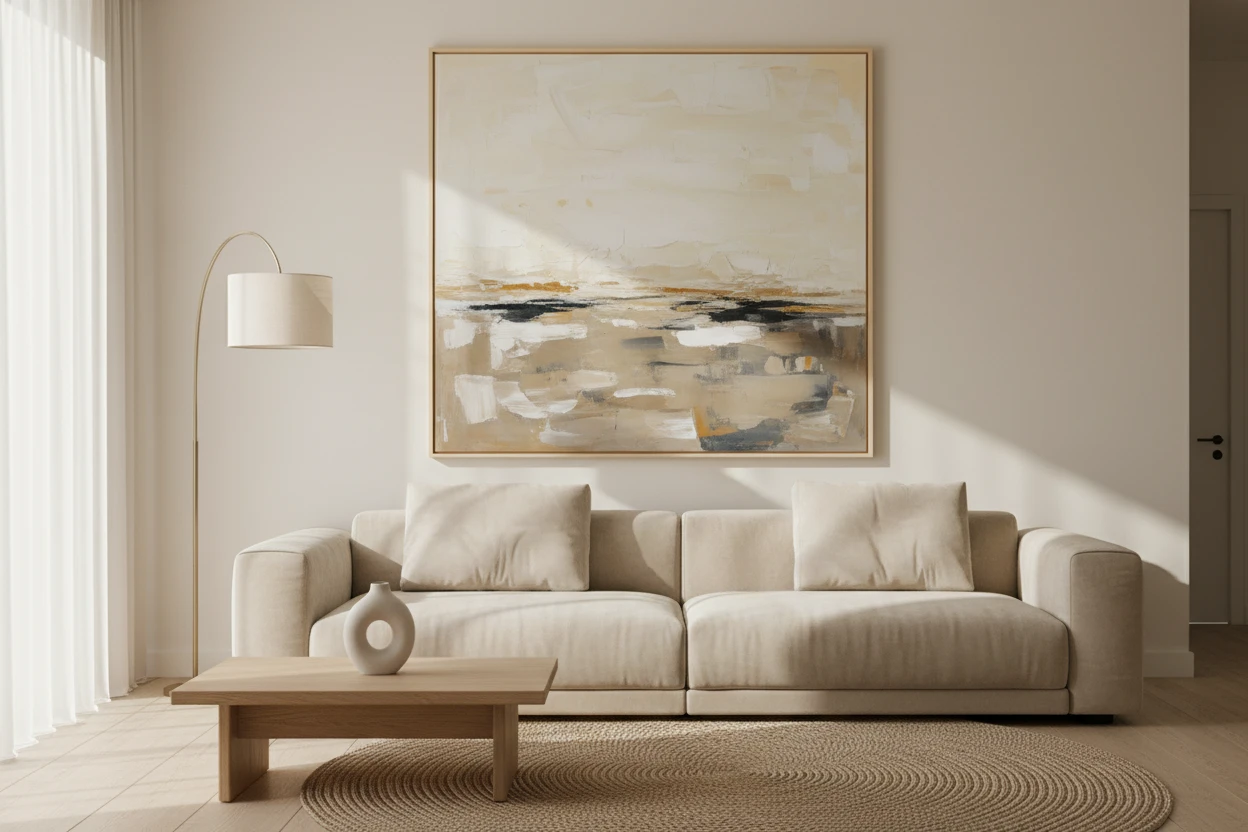
Why Your Room Doesn’t Feel Finished (And What Actually Fixes It)
Authored by: Murah Mukundu
There’s a moment most people recognise. The room is painted, the furniture is in place, the art is hung. And yet something still feels off. Not bad, exactly. Just unresolved.
I’ve thought about this a lot, both in my own home and through conversations with people who care deeply about the spaces they live in. The answer is almost never another piece of furniture.
What’s usually missing is texture, weight, and something with a bit of genuine character.
Here’s what I’ve come to understand about how natural materials can pull a room together, and how to use them without overcomplicating things.
Why “finished” has nothing to do with more stuff
A room reads as complete when it holds a real range of contrasts. Soft against hard. Rough against smooth. Light sitting next to something that feels dense and grounded.
The problem is that most modern interiors are built almost entirely from soft, engineered surfaces: upholstered sofas, painted walls, printed textiles. These all speak the same visual language, which is fine on its own, but without something raw and tactile to push against, the eye has nowhere to land.
Natural stone changes this quickly. It carries a kind of texture that can’t be replicated: banding, crystalline structure, a sense of real mass and age. Bring one honest piece into a room, and suddenly the other elements start to look intentional rather than just placed.
Weight matters here too, and it’s the part people tend to overlook. A heavy object grounds a surface. It communicates permanence. That’s a lot of what “finished” actually means.
One anchoring object per surface
Before deciding what to add, it helps to resist the instinct to fill space. Scattered small objects across multiple surfaces rarely read as curated. They read as accumulated.
My working rule is one object per surface that truly earns its place. I ask three things about it:
- Does it have real texture or character? A raw mineral specimen or a polished agate slice carries depth that a mass-produced ornament simply can’t replicate.
- Does it have visual weight? One larger, sculptural piece almost always does more than three smaller ones.
- Is it actually individual? Natural stone is never the same twice. That inherent uniqueness is what makes something feel personal rather than sourced from a catalogue.
When an object passes all three, a surface stops feeling decorated and starts feeling considered.
Three places where this works well in practice
On a coffee table. A substantial agate bowl placed centrally does a lot of work. Keep it mostly empty. The polished interior catches the light and gives the table a focal point without cluttering it.
On a console or in a hallway. Entryways are chronically under-styled. A carved decorative stone object with real height brings in the weight and presence these spaces usually lack. Pair it with one stem in a simple vase and leave it at that.
On a shelf or bedside table. A smaller mineral specimen, an agate freeform or a polished sphere, works well here to break up rows of books or picture frames. The organic form interrupts the straight lines without trying to compete with them.
The logic is the same in all three cases. One tactile, honest piece does more than several decorative fillers.
The mistake I see most often
People arrange objects in symmetrical pairs and assume the balance will read as polish. It often doesn’t. Matching pairs of similar objects create repetition, and repetition tends to flatten a space rather than enliven it.
What breaks that pattern is introducing one piece that doesn’t quite follow the rules. Something raw and slightly irregular is placed alongside neat, matching elements. That contrast is what makes the arrangement feel chosen rather than assembled.
What to take from this
Finishing a room is mostly an editing problem, not a shopping one. It’s about identifying where contrast is missing and introducing something with genuine physical presence into that gap.
Pick one surface this week. Clear it completely, then bring back just one piece with real texture and weight. See how the space reads differently.
Which surface in your home has never quite felt resolved?
Murah Mukundu is the founder of The Mineralogie Company, a London-based studio specialising in ethically sourced mineral specimens and sculptural stone objects for refined interiors. themineralogiecompany.com