

The Hidden Costs of Manual Print Order Management
Authored by: Naimish Patel
For print service providers, the real drain on profitability isn’t paper or ink. It’s the hours spent chasing orders, correcting file errors, and reconciling mismatched quotes in spreadsheets.
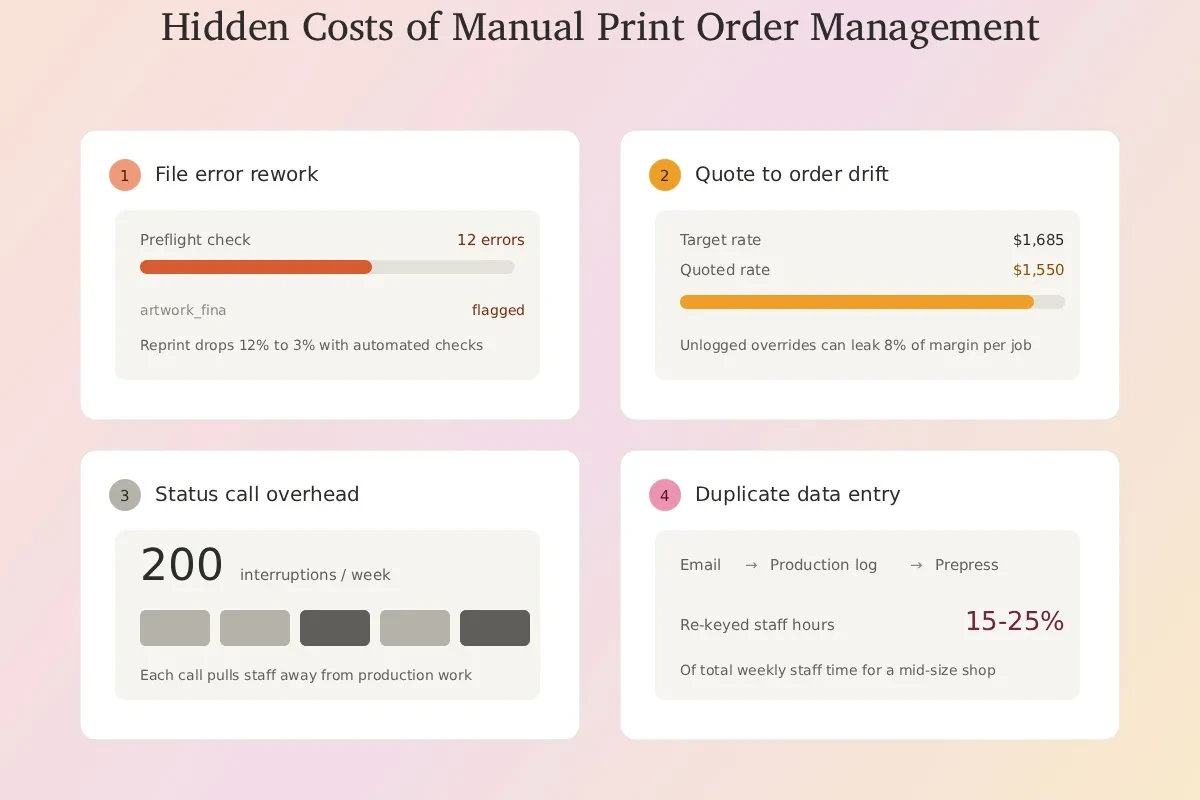
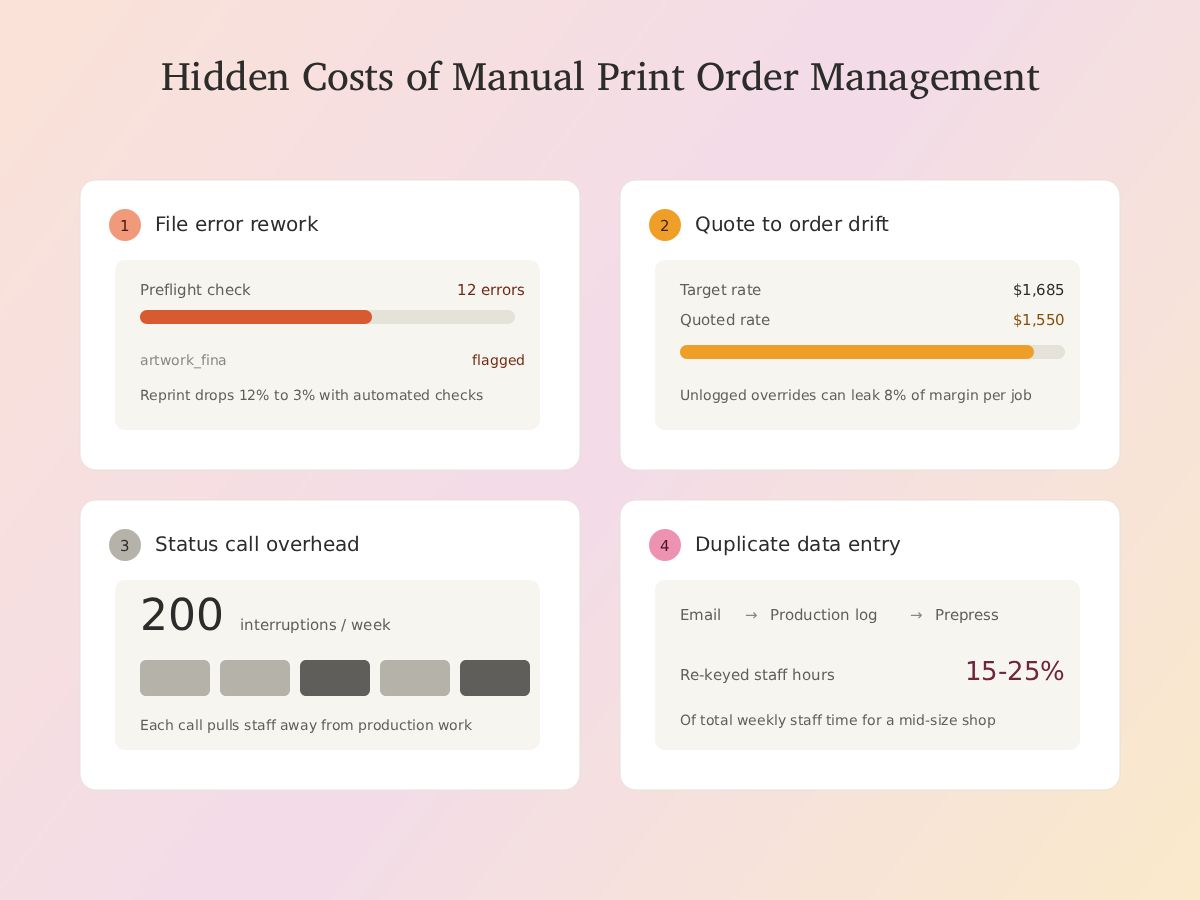
Ask most print shop owners where their margin goes, and they’ll mention substrate costs, equipment depreciation, or competitive pricing pressure. Rarely does anyone say: order management. Yet for a mid-size print service provider handling 50 to 200 jobs per week, manual order handling (emails, phone calls, rekeyed data, and reformatted artwork) can consume 15 to 25 percent of total staff hours. That’s a hidden cost hiding in plain sight.
Where the Hours Actually Go
Manual print order management isn’t one problem. It’s ten small problems compounding against each other. Consider a typical wide-format PSP taking a custom signage order: the customer emails artwork, a CSR downloads it, eyeballs file specs, emails back a quote, waits for approval, re-enters the job into a production log, hands off to prepress, and then updates the customer when the order ships.
Every handoff is a potential error. Every re-entry is duplicate work. A study by McKinsey found that employees in process-heavy roles spend nearly 20 percent of their time searching for information or correcting avoidable mistakes. For print shops, that translates directly to delayed turnaround times, missed SLAs, and frustrated repeat customers.
The cost compounds when volume increases. Adding a second shift or a new product line doesn’t just double revenue. It can double the administrative burden too, unless the underlying workflow is structured to scale.
Three Hidden Cost Categories Most Shops Overlook
1. Rework from file errors that slip through informal review
When artwork arrives via email rather than a structured online portal with built-in preflight checks, low-resolution files, wrong color profiles, and missing bleeds don’t get caught until prepress, or sometimes after a proof is already printed. Each reprinted job that traces back to an unchecked file silently eats into the margin. Industry data suggests 250 kg to 300 kg of paper every year, including the production waste in shops without automated preflight.
2. Quote-to-order mismatches and discount leakage
When pricing lives in someone’s head or in an unlocked spreadsheet, quotes drift. A CSR approximates a per-square-metre rate. A manager overrides a substrate upcharge during a phone call. No one logs the exception. By the time the invoice goes out, the job has been priced 8 percent below target. Multiply that across 30 jobs per week and the revenue leak becomes material, often without anyone realizing it until an annual review.
3. Customer communication overhead
Order status inquiries are among the most time-consuming interactions a print shop handles. When customers can’t self-serve job tracking, they call or email. Answering those inquiries pulls CSRs away from value-generating work. For a shop with 100 active jobs, even two status calls per job per week adds up to 200 interruptions, each one fragmenting attention and slowing throughput.
What Structured Order Management Actually Changes
The shift from ad-hoc order handling to a structured web-to-print workflow isn’t just a technology upgrade. It’s a redefinition of where staff spend their time. When customers submit jobs through a configured online storefront, several things happen at once: artwork is validated automatically, pricing is calculated from a live rule engine, and job data flows directly into production without rekeying.
For one commercial printer we work with through OnPrintShop, implementing an online B2B storefront reduced order-entry time per job by roughly 40 percent. More importantly, their reprint rate (jobs that had to be redone due to file or specification errors) dropped from around 12 percent to under 3 percent within the first quarter. The savings were real, but the bigger change was organizational: staff attention shifted from reactive fire-fighting to proactive relationship management.
A second example: a wide-format shop managing custom signage quotes used to handle pricing through a combination of email threads and a shared spreadsheet. Introducing a configured pricing engine with substrate-specific per-square-metre rates eliminated the informal overrides. Quote-to-invoice consistency improved immediately, and the sales team reported spending less time justifying prices and more time closing new accounts.
The Right Starting Point for Print Operations Teams
Before investing in new software, print operations leaders benefit most from a 30-minute audit of their current order flow. The key questions are:
• How many touchpoints exist between a customer submitting a job and that job entering production?
• Where are pricing decisions made, and are they logged consistently?
• What percentage of incoming artwork files require manual correction before prepress?
• How do customers currently find out where their order stands?
The answers almost always reveal a concentration of friction at two points: order intake and job status communication. Those are the highest-return areas to structure first.
Manual processes aren’t just slow. They are structurally inefficient at scale. The shops that grow profitably are the ones that recognize this early and build the workflow discipline before volume forces the issue.
About the Author
Naimish Patel brings 17+ years of experience in helping print businesses grow through smarter technology. As Vice President of Sales at OnPrintShop, he works with global print providers to streamline operations, automate workflows, and enhance online buying experiences. He is a regular voice at global print events and industry forums. Naimish shares practical insights on web-to-print innovation and scaling print businesses efficiently.